Government as an Economic Actor

Public working draft for review: Google Docs remains canonical. Simon Halliday authorized website publication for content and figure review on August 26, 2026. This AI-assisted feasibility draft is not an approved final chapter. The empirical hook, remaining figures, quantitative claims, provenance, rights, accessibility, and coauthor review remain incomplete or flagged.
Focal principles: Rules of the game principle; Principle of gains from cooperation and conflict of interest; Principle of individual and societal interests.
AI-assisted working draft — published for review, not approved as a final chapter. This draft was initialized with AI assistance from the approved chapter brief and named sources. Human authors and editors retain authority over wording and decisions. Preserve comments, suggestions, revision history, attribution, and accepted human edits. Simon Halliday provides final editorial and publication approval.
Draft basis and source hierarchy
The main theoretical spine comes from The Economy 2.0: Macroeconomics, Unit 10, especially government as an economic actor and the distinctions among economic, political, and administrative feasibility. The chapter expands this macro treatment through US federalism, national accounts, public finance, procurement, implementation, and capacity. TE 2.0 Micro public-goods, external-effects, and principal–agent material is used only as a compact prerequisite bridge. UTE Chapters 16 and 17 provide selective cross-references for incomplete contracts, wealth, risk, and authority; they are not the main content.
Evidence status: the Miller suffrage and child-mortality data route has been located but the historical hook has not yet passed independent reproduction. BEA and Census files remain to be pinned and reviewed. The hook below therefore contains explicit production flags and no unverified estimate.
Learning objectives
By the end of the chapter, you should be able to distinguish government rule-making, taxation, transfers, insurance, provision, procurement, regulation, and stabilization; separate government purchases from transfers; explain why statutory tax payment and economic incidence can differ; compare public provision, contracting, and regulation through goals, information, authority, and risk; identify an administrative-capacity constraint; explain how federal, state, local, tribal, and territorial authority can overlap; and evaluate evidence about public action without treating government as one unitary decision maker.
17.1 When political rights change public action
At the beginning of the twentieth century, state and local governments made decisions that shaped water, sanitation, disease prevention, and public health. Women in many states were affected by these decisions while lacking equal voting rights. States extended women’s suffrage at different times before the national constitutional change. This staggered timing creates an opportunity to ask whether political rights changed government action and health outcomes.
The proposed opening figure is based on Grant Miller’s historical study. It will be inserted only after the corrected mortality data and harmonized municipal-finance data have been independently reproduced. The final sequence must show which states changed voting rules when, which states serve as comparisons, the outcome unit, pre-change patterns, uncertainty, and the bounded population and period. It must not reproduce a publisher figure or turn a before-and-after pattern into a causal claim.
[EVIDENCE FLAG ch17-DAT-001: insert independently reproduced hook estimate and figure only after quantitative and historical review. If reproduction fails, use the documented administrative-capacity fallback.]
Even a credible estimate would not imply that voting rights mechanically produce a fixed amount of spending or a universal health effect. The proposed mechanism passes through political incentives, public-health priorities, revenue, administrative organizations, and services. Other conditions also changed. The evidence can answer a bounded historical question, not every question about democracy or public health.
The case opens a macroeconomic problem. Political authority can change, yet an enacted decision still has to become a budget, staff, procurement, information, enforcement, and service delivery across places. What can governments do that households and firms cannot do alone, and how do authority, capacity, scale, and implementation shape the results?
Source adaptation note
The opening case should be read as an implementation chain, not only as an estimate. A change in voting rights can alter the incentives of candidates and officeholders. A changed priority must then enter budgets and laws. Public-health organizations need staff, information, supplies, and authority. Local actions must reach households and environments where disease risk is produced. Each link can strengthen, delay, or block the effect.
This chain helps students distinguish the treatment from the mechanism. The legal extension of suffrage is the institutional change used by the research design. Public-health spending and activity are proposed mediators. Child mortality is an outcome. If spending rises after suffrage and mortality falls, the design still needs evidence that the timing differs systematically from comparison states and that other state-specific changes do not explain the pattern. A mechanism story is not a substitute for identification.
The final hook figure should therefore have four steps. First, show when states changed voting rights and define the comparison. Second, display pre-change outcome patterns so students can inspect the logic of parallel trends. Third, show the estimated change with uncertainty and the precise population and period. Fourth, add the public-health spending or activity evidence, labeling it as mechanism evidence with its own limitations. The sequence should not use chronology alone to draw an arrow marked “causes.”
Historical context matters because the public sector was organized differently from today. State and local responsibilities, revenue systems, disease environments, medical knowledge, racial exclusion, and women’s political rights varied across time and place. The chapter must not imply that all women had equal political voice after formal suffrage or that the extension eliminated racial disfranchisement. A bounded result can still be important while leaving those exclusions visible.
The case also shows why government is a macroeconomic actor. Public decisions mobilize labor and resources, create infrastructure, change survival and human capability, and affect future production and wellbeing. These effects are not captured by asking only whether a private transaction occurred. The bridge is organizational: what forms of authority and capacity make coordinated public action possible?
Source adaptation note
Questions
Question 17.1. Why is a comparison using different state suffrage dates stronger than a simple national before-and-after story?
- It can use variation in timing and comparison states while still requiring assumptions
- It proves every proposed mechanism
- It removes historical differences across states
- It makes uncertainty irrelevant
Exercise
Label a causal design
Write four labels for the planned hook figure: treatment, comparison, outcome, and identifying assumption. State one conclusion a verified design might support and one generalization it could not support.
The model solution is available in the restricted instructor materials.
17.2 What governments do
A government is not simply a large household. It can make and enforce law, compel payment of taxes, define rights, prohibit conduct, issue money through authorized institutions, adjudicate disputes, and act across a territory. These powers can make cooperation possible at a scale unavailable to private actors. They can also be used coercively or unequally, so legitimacy, rights, accountability, and legal limits matter.
Government action takes several forms. Rules define property, contracts, corporations, labor standards, environmental limits, and civil rights. Taxes raise revenue and change incentives. Purchases pay for currently produced goods and services. Transfers move resources without purchasing current production from the recipient. Social insurance pools specified risks. Public organizations employ workers and produce services. Procurement contracts with private or nonprofit organizations. Regulation sets and enforces conditions on private action. Information, standards, persuasion, and coordination can change behavior without direct production.
These tools are used by distinct organizations. Congress and state legislatures enact laws and budgets. Executives and agencies administer them. Courts interpret and enforce legal obligations. Public employees exercise professional and delegated authority. Contractors respond to contract terms. Federal, state, local, tribal, and territorial governments possess different jurisdictions and resources. A sentence beginning “the government decided” should usually name which institution had authority and which organization implemented the decision.
TE 2.0 Macro emphasizes that public policy must be feasible in more than one sense. Economic feasibility asks whether resources and technologies can produce the intended result. Political feasibility asks whether a decision can be selected and sustained through existing institutions and power relationships. Administrative feasibility asks whether organizations can implement it. Chapter 17 concentrates on tools and administrative capacity. Chapter 18 develops participation, unequal voice, organized interests, accountability, and political feasibility.
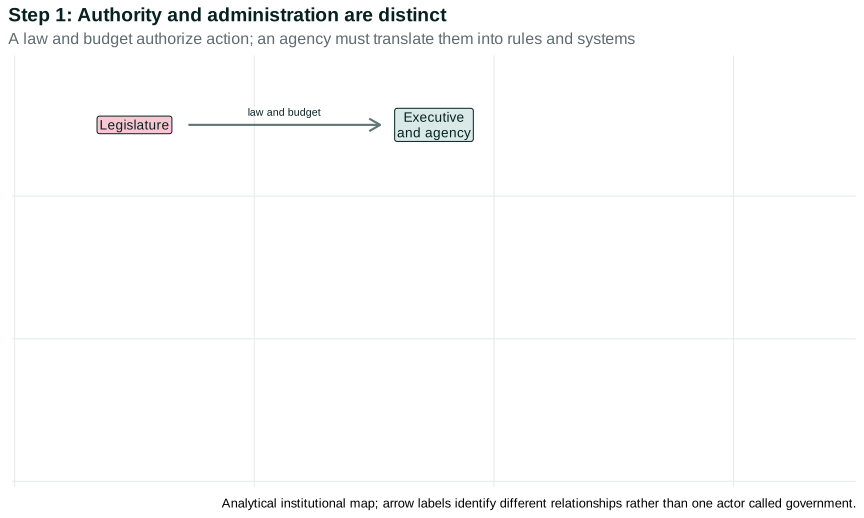
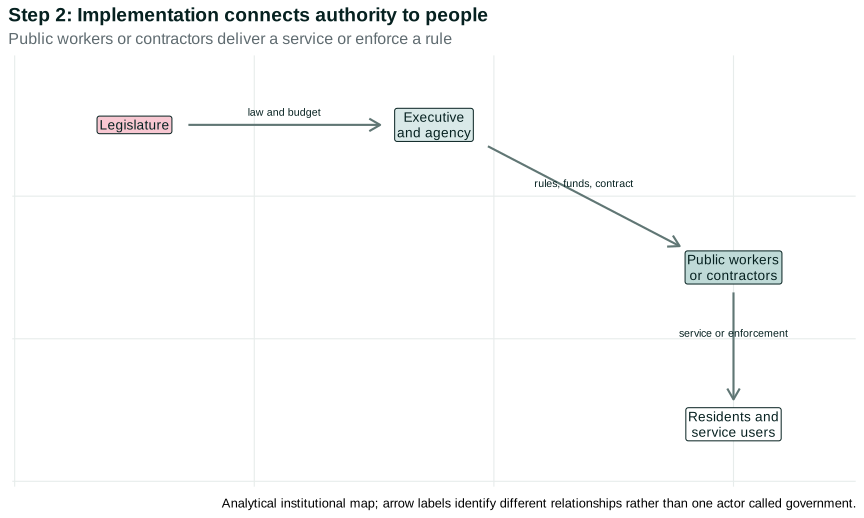
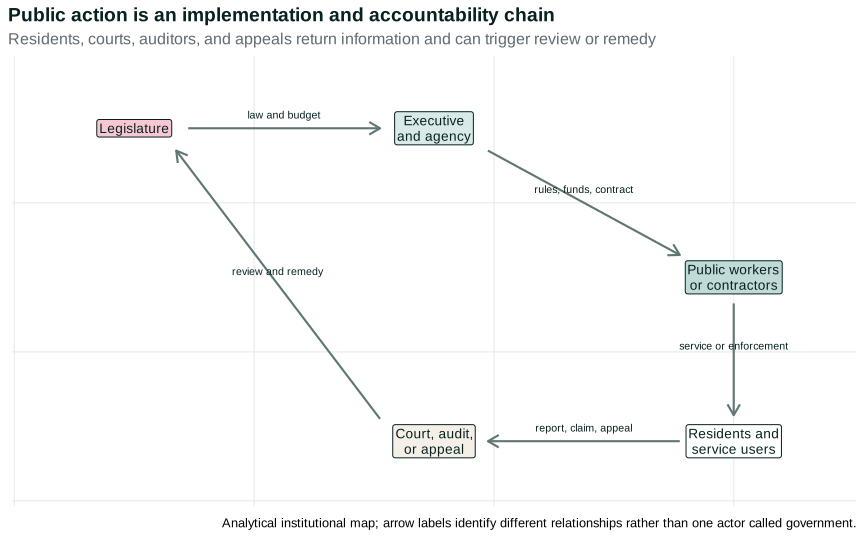
Source adaptation note
Government action can be organized by what flows between actors. Law creates permissions, duties, and prohibitions. Taxes move money to public budgets. Transfers move money or in-kind resources to eligible recipients. Purchases move money to suppliers in exchange for current production. Public provision combines budgets, workers, and assets inside public organizations. Regulation changes the terms under which private actors may operate. Information flows support monitoring and coordination.
This transaction view prevents “spending” from swallowing the entire public sector. A workplace safety rule can change production without a large public expenditure. A loan guarantee can shift risk while producing little immediate outlay. A tax expenditure can support an activity through foregone revenue. A court decision can redefine rights. Public employment and procurement can involve similar services but different authority and accountability.
Different branches and levels constrain one another. A legislature may authorize a program and appropriate funds. An executive agency writes rules and administers contracts. Courts review legality. State or tribal governments may possess implementation authority. Local organizations deliver services. Auditors, inspectors, and residents provide information. The resulting policy is a system of delegated relationships, not the choice of one person called “government.”
Coercive authority deserves explicit treatment. Tax collection, policing, regulation, and compulsory rules can solve collective-action problems and protect rights. They can also impose harm, particularly where enforcement is unequal or appeal is inaccessible. Legitimacy is not merely a preference that makes compliance convenient. Constitutional and civil rights restrict what public actors may do even when a policy could raise an aggregate measure.
Scale changes feasible action. A national government can pool risks across regions and time, issue widely accepted liabilities, and coordinate standards. State and local governments may have better contextual information but narrower tax bases and balanced-budget constraints. Tribal nations exercise sovereignty within distinct legal relationships. No level is universally best; functions differ in spillovers, information, redistribution, and need for uniform rights.
The feasibility framework can be taught with a three-column table. Economic feasibility identifies real resources and technology. Administrative feasibility identifies authority, organizations, workers, data, procurement, and time. Political feasibility identifies selection and durability. The columns interact: administrative failure can weaken political support, and political conflict can withhold resources needed for administration.
Source adaptation note
Questions
Review the live step-by-step figure
Question 17.2. Why is a government not equivalent to a household?
- It can exercise legally authorized rule-making and coercive powers across a jurisdiction
- It does not face real resource constraints
- Every public organization has the same goals
- Its spending requires no financing arrangement
Exercise
Map public authority
Choose one public service. Identify the authorizing body, funding source, implementing organization, worker or contractor, recipient, oversight body, and one point at which implementation can fail.
The model solution is available in the restricted instructor materials.
17.3 Public goods, external effects, and collective action
Some economic problems involve effects that individual transactions do not fully contain. An external effect occurs when an action directly affects others in a way not captured in the decision maker’s private costs or benefits. A public good is non-rival when one person’s use does not substantially reduce another’s and non-excludable when preventing access is difficult. These characteristics can create free-riding and underprovision.
The labels do not prove that one government response is best. A pollution problem might be addressed through a rule, tax, tradable permit, public investment, information, bargaining, or a combination. A neighborhood may manage a shared resource through community rules. A government may lack information, face enforcement limits, or be influenced by organized interests. The task is to identify the particular interdependence, feasible institutions, and distribution of costs.
Consider vaccination information, flood protection, or clean air. Households and firms have different exposure, resources, and ability to avoid harm. A policy that raises total benefits can still impose concentrated losses. Compensation, participation, rights, and baseline entitlements matter; an efficiency calculation cannot decide fairness by itself.
Collective action also appears inside government. Agencies need information from residents and firms. Jurisdictions depend on one another when pollution, disease, transportation, or migration crosses borders. Each may prefer others to bear the cost. Grants, standards, compacts, and federal authority can change incentives, but they add reporting, compliance, and coordination requirements.
Source adaptation note
Source adaptation note
Public goods and external effects are best understood as structures of interdependence. If an upstream firm releases pollution into a river, downstream households and firms face effects not contained in the upstream transaction. If flood protection benefits an entire area and exclusion is difficult, each property owner may hope others will pay. The problem is not that people have bad preferences; private choices are made with costs and benefits that do not match the full social consequences.
A response changes incentives and authority. A pollution tax makes a payment depend on measured emissions. A performance standard limits emissions directly. Tradable permits create a total limit and transferable rights. Public investment can make cleaner production feasible. Disclosure can change customer or investor decisions. Bargaining may work when parties and harms are limited and rights are clear. Each tool requires information and enforcement.
Distribution enters at three points. Baseline rights determine whether a polluter must pay or exposed residents must tolerate or bargain over harm. Policy cost depends on who can adjust and who receives revenue. Benefits depend on exposure and vulnerability. A uniform price can have unequal effects when income, health, housing, and alternatives differ. Efficiency gains do not answer whether the baseline or distribution is just.
Government failure should be analyzed with the same specificity. An agency may lack emissions data, face legal constraints, be influenced by regulated firms, or impose a rule that entrenches incumbents. A local government may compete for tax base and under-regulate a cross-border harm. Residents may lack access to hearings. These are mechanisms requiring institutional alternatives, not proof that private action has no problem.
Collective action also includes voluntary and community institutions. Neighborhood associations, unions, professional organizations, cooperatives, and Indigenous governance can create rules and monitor behavior. Their effectiveness depends on membership, authority, inclusion, and scale. The chapter should compare them with public tools where appropriate rather than treating markets and government as the only possibilities.
The macro link arises when effects are widespread or cumulative. Pollution can affect health, labor supply, capital, and public budgets. Epidemic control changes participation and demand. Standards can redirect investment and innovation. Public goods therefore connect individual incentives to aggregate capacity and risk.
Source adaptation note
Questions
Question 17.3. What is the strongest conclusion after identifying an external effect?
- No institutional response can improve the outcome
- One particular tax is automatically the best response
- Compare feasible institutions, information, enforcement, rights, and distribution
- Private actors cannot participate in collective action
Exercise
Compare institutional responses
For a local flood-risk problem, compare one private, one community, and one government response. For each, identify information needs, authority, financing, and who bears residual risk.
The model solution is available in the restricted instructor materials.
17.4 Taxes, transfers, and social insurance
Taxes finance public action and alter private choices. A tax base specifies what is taxed—income, payroll, consumption, property, profit, or another measure. The statutory payer is the person or organization legally responsible for remitting the tax. Economic incidence asks whose real income or opportunities change after wages, prices, profits, quantities, and behavior adjust.
Suppose an employer remits a payroll tax. The legal obligation is clear, but the economic burden might be shared through lower wages, higher prices, lower profits, or employment changes. The division depends on alternatives, bargaining, market conditions, and time. The chapter uses an analytical example rather than claiming one incidence result applies to every tax.
Transfers provide cash or resources without purchasing current production from the recipient. Government purchases, by contrast, pay for current goods and services and enter GDP expenditure directly. Both can change wellbeing and aggregate demand, but they occupy different national-account categories. Confusing them leads to double counting and mistaken claims about the “size” of government.
Social insurance pools risks such as unemployment, disability, illness, or longevity under public rules. Contributions, eligibility, benefits, and administration determine who is insured and which risks remain with households, employers, or taxpayers. Insurance can support consumption and bargaining power during a shock. It can also create exclusions, administrative burdens, and behavioral responses.
Automatic stabilizers connect this institutional design to the macroeconomy. During a downturn, tax payments may fall and eligible transfers may rise without a new law for each household. Disposable income and spending are supported, which can reduce the contraction. The effect depends on coverage, benefit timing, take-up, financing, and the spending responses of recipients.
Source adaptation note
Tax systems can be compared along the base, rate structure, unit, timing, administration, and incidence. An individual income tax uses a person or tax unit’s defined income. A payroll tax is linked to earnings. A sales tax applies to specified purchases. A property tax uses assessed property value. A corporate income tax applies to defined corporate profit. The legal label alone does not identify the economic burden.
Adjustment occurs through choices and bargaining. If a tax raises a firm’s cost, it may change prices, wages, hiring, investment, location, or profit. Consumers may substitute products. Owners may receive lower returns. The response depends on alternatives and time. A short-run incidence can differ from a long-run incidence as capital, workers, and contracts adjust. An empirical estimate for one tax and period should not be transferred automatically to another.
Progressivity can refer to statutory rates, payments relative to income, or the combined distribution of taxes and benefits. A tax can be regressive by one measure while financing benefits that are progressive. Incidence should be analyzed for the fiscal system and for particular mechanisms, without hiding either. Administrative compliance and avoidance also differ across groups with access to lawyers, accountants, cash transactions, or mobile assets.
Transfers and insurance require eligibility rules. Universal programs simplify some boundaries but still need records and delivery. Means-tested programs target resources but create applications, income definitions, recertification, and phase-outs. Social insurance links contributions or covered status to benefits, yet workers with unstable employment or excluded categories may have weaker protection. Program design distributes both money and administrative risk.
Automatic stabilization can be traced in spending rounds. When income falls, progressive taxes decline and eligible benefits rise. Recipients with urgent needs may spend much of the support, sustaining revenue for firms and income for workers. The aggregate effect depends on timing and coverage. Delayed benefits cannot stabilize the month in which rent is due, and non-take-up weakens both insurance and macro support.
Financing matters over time. A federal government with monetary and borrowing authority has different constraints from a state or local government. Debt shifts tax and spending claims across time and creates assets for holders. Sustainability depends on interest, growth, currency, institutions, and political capacity, not a household analogy. Chapter 9 provides the fiscal-policy foundation; this section places the budget inside the wider public toolkit.
Source adaptation note
Questions
Question 17.4. Who bears a tax economically?
- The actor named as the statutory remitter
- People whose real income and opportunities change after adjustment
- Only workers employed by the tax authority
- No one when the revenue funds a benefit
Exercise
Classify public transactions
Compare a government purchase, cash transfer, and social-insurance benefit. Identify the transaction, GDP treatment, eligibility or contract, risk allocation, and one possible aggregate-demand effect.
The model solution is available in the restricted instructor materials.
17.5 Public provision, procurement, and regulation
A government pursuing a goal can provide a service directly, buy it from another organization, or regulate private provision. Each form assigns authority, information, monitoring, and risk differently.
Direct provision gives a public organization control over staffing, procedures, and assets. It may support universal access, professional norms, and continuity. It also requires managerial and technical capacity. Procurement can use specialized suppliers and flexibility, but writing and monitoring a complete performance contract is difficult. Regulation leaves production with private organizations while setting conditions, which requires information, inspections, enforcement, and credible penalties.
The principal–agent problem appears in each form. Legislators or executives delegate to agencies. Agencies delegate to public employees or contractors. Citizens depend on all of them. Goals may differ, effort and quality can be hard to observe, and performance measures can be gamed. A narrow target may crowd out unmeasured service quality. Monitoring can improve accountability while shifting time toward paperwork.
This is the appropriate role for the UTE principal–agent material: it supplies a concrete explanation of incomplete contracts and monitoring, while TE 2.0 Macro supplies the government and feasibility architecture. The public setting adds multiple principals, legal obligations, professional authority, and democratic accountability. It cannot be reduced to a lender–borrower or employer–worker pair.
Distribution matters. A contractor’s cost saving may become lower prices, higher profit, lower wages, or reduced service quality. A regulation can protect health while raising costs that different households and firms absorb differently. Public workers can possess expertise and voice but also face political pressure and resource constraints. Comparing make, buy, and regulate requires outcomes, not labels.
Source adaptation note
Source adaptation note
The make–buy–regulate choice begins with the outcome that must be delivered. Is quality easy to observe? Does continuity matter? Are there several capable suppliers? Does the service involve coercive authority, confidential information, or rights? Can a contract specify adaptation after an emergency? The answers shape which organizational form is feasible.
Direct provision can build public expertise and retain learning. Public employees may be governed by professional norms, civil-service protections, collective bargaining, and public-record rules. Those institutions can support independence and voice, but they can also create rigid procedures or diffuse accountability. The relevant question is how actual rules affect performance and rights.
Procurement creates a purchaser–provider relationship. Competition for a contract may reveal costs and attract specialized capacity. But once a provider has made specific investments or become indispensable, bargaining changes. A lowest-price award can encourage cost cutting on dimensions that are hard to measure. A cost-plus contract can protect quality or encourage spending. Contract design allocates adaptation and failure risk.
Regulation leaves production and many decisions with private actors. A performance rule specifies an outcome; a technology rule specifies a method. Performance rules allow flexibility but require measurement. Technology rules are easier to inspect but can freeze methods or favor incumbents. Enforcement needs detection, due process, penalties, and resources. A rule without credible enforcement changes few incentives.
Multiple principal–agent relationships complicate accountability. Citizens elect officials; officials oversee agencies; agencies contract with organizations; managers supervise workers; clients depend on the service. Each link transmits imperfect information. A performance indicator chosen for legislative oversight may distort frontline work. A contractor can comply with measurable terms while failing the underlying purpose.
Power and class shape the chain. Large firms can bear bidding costs, finance delays, and influence standards. Small providers may possess local knowledge but lack working capital. Public workers face authority and job risk. Service users differ in their ability to complain, litigate, or exit. Procurement and regulation therefore affect ownership, employment, and voice as well as technical delivery.
Source adaptation note
Questions
Question 17.5. Why can procurement be difficult to govern?
- Quality and effort may be hard to specify and verify in a contract
- Every service dimension is easily measurable
- Contractors do not pursue goals of their own
- Monitoring requires no public resources
Exercise
Make buy or regulate
Compare direct provision, procurement, and regulation for one service across control, expertise, monitoring, flexibility, worker conditions, access, and failure modes.
The model solution is available in the restricted instructor materials.
17.6 Capacity, scale, and federalism
Legal authority is not the same as capacity. An agency needs revenue, staff, expertise, data systems, offices, equipment, procedures, and relationships with other organizations. It needs enough time to learn and enough legitimacy for people to participate. A program may be authorized and funded yet fail because applications are inaccessible, contractors are unavailable, or local offices cannot process cases.
Administrative burdens shift risk. Forms, documentation, waiting, travel, digital access, language, disability access, and discretionary encounters consume resources. People with flexible work, savings, transportation, and institutional familiarity can navigate burdens more easily. Non-take-up may therefore reflect program design rather than a lack of need.
Federalism divides and overlaps authority. The federal government may finance or set standards; states may administer; counties, cities, school districts, public authorities, or tribal governments may deliver. Intergovernmental transfers move funds with conditions and reporting requirements. Decentralization can allow adaptation and learning while producing unequal access where tax bases and administrative resources differ.
Tribal governments are sovereign political entities, not another type of local government. Federal, state, and tribal authority can overlap in ways shaped by treaties, statutes, courts, and nation-to-nation relationships. A general federalism diagram must not erase that distinct status.
Capacity can reinforce itself. Effective collection and service delivery can build information, experience, and trust, supporting revenue and compliance. Austerity, turnover, fragmentation, and failed systems can weaken capacity and future performance. These feedbacks help explain why identical statutory rules produce different results across places.
Source adaptation note
Capacity is specific to a task. A government may collect taxes effectively and deliver benefits poorly, or run schools while lacking emergency procurement. Staffing numbers do not reveal skills, turnover, authority, or information systems. Spending does not show whether resources reach frontline organizations. Capacity should be measured through the implementation chain relevant to the outcome.
State capacity is often described as the ability to implement collective decisions. That ability includes fiscal capacity to raise revenue, legal capacity to make and enforce rules, informational capacity to know what is happening, and administrative capacity to organize people and processes. These dimensions can support rights and services or coercion and extraction. More capacity is not automatically better without asking whose goals and legal limits it serves.
Frontline workers exercise discretion because rules cannot anticipate every case. Discretion can adapt a program to individual circumstances, correct rigid categories, and use professional judgment. It can also produce unequal treatment, delay, or arbitrary denial. Training, workload, appeals, worker voice, data systems, and supervision shape how discretion operates.
Administrative burdens accumulate across programs. A household may submit similar documents repeatedly to separate agencies. A small business may face overlapping permits. Fragmented systems can protect specialized authority or privacy while creating duplication. Data sharing can reduce burden but introduce surveillance, security, and error risks. Digitalization changes rather than eliminates the capacity problem.
Intergovernmental design allocates functions and finance. Matching grants change the local price of spending. Block grants provide discretion but may weaken national standards. Unfunded mandates require action without adequate resources. Equalization transfers can reduce fiscal disparities. Conditions can protect rights while adding compliance cost. The mechanism should identify which level decides, pays, administers, and bears failure.
Learning is a form of capacity. Programs generate information about take-up, cost, quality, and unintended effects. Organizations need staff and authority to interpret the information and revise practice. Punitive oversight can discourage reporting problems; transparent evaluation can support improvement. Institutional memory is lost through turnover and short contracting cycles.
Source adaptation note
Questions
Question 17.6. What is administrative feasibility?
- Whether authority, people, information, organizations, and processes can implement a policy
- Whether a policy has an appealing title
- Whether public resources are unlimited
- Whether a proposal has entered a legislature
Exercise
Trace an intergovernmental grant
Trace a grant from authorization through funding, state or tribal choice, local administration, frontline delivery, recipient access, and reporting. Mark two points where delay or exclusion can arise.
The model solution is available in the restricted instructor materials.
17.7 Data Extension: measuring the public sector
There is no single measure of government size. BEA national accounts organize current receipts and expenditures for macroeconomic analysis. Census government-finance data describe revenues, expenditures, debt, and assets across state and local governments using another accounting system. Employment data count workers. Regulatory authority, guarantees, tax expenditures, and legal rules may be economically important without appearing as ordinary purchases.
Government purchases pay for currently produced goods and services. Transfers redistribute purchasing power. Interest payments compensate holders of government debt. Grants between governments can appear in more than one set of accounts unless measures are consolidated. Adding federal, state, and local totals without checking intergovernmental flows can double count.
The planned Data Extension will reconcile a BEA table with a Census table after files, lines, and vintages are pinned. Students will identify government level, time period, current versus capital categories, receipts versus expenditures, and consolidation. They will then explain why neither table alone measures effectiveness, legitimacy, or distribution.
[EVIDENCE FLAG ch17-BEA-CEN-001: insert reviewed table values only after pinning, checksum, category reconciliation, and quantitative review.]
Source adaptation note
The Data Extension should begin by assigning each dataset a question. BEA national accounts ask how government transactions fit into aggregate production, income, and expenditure. Census government-finance data ask how state and local governments receive and use funds under their survey classifications. Employment sources ask how many people work for public organizations. Budgets ask what a jurisdiction legally plans or authorizes. The numbers differ because the questions differ.
Consider a federal grant to a state that purchases a locally produced service. In an unconsolidated finance table, the federal payment may appear as federal expenditure and state intergovernmental revenue, while the state’s purchase also appears as expenditure. Adding every entry would count the transfer and the final purchase as if they were separate produced services. Consolidation removes flows within the combined government sector for a particular purpose.
Transfers to households differ again. A cash benefit raises disposable income but is not payment for current production. When the household spends it, consumption expenditure enters GDP. The transfer can have a large behavioral and distributional effect without being a government purchase. A government employee’s compensation, by contrast, is part of the cost used to value public production.
Capital spending and depreciation require careful treatment. Building infrastructure creates a public asset, while maintenance preserves capacity and current services. Cash budgets, fund accounting, and national accounts may record timing differently. Debt issuance finances transactions but is not itself revenue from current production. Interest is a payment on a financial claim, not a purchase of a newly produced bridge.
Price adjustment matters for trends. Rising nominal spending can reflect higher prices, population, wages, service intensity, or broader programs. A share of GDP answers a different question from real spending per person. Cross-state comparisons need attention to responsibilities, price levels, intergovernmental transfers, and population needs. A league table without those definitions invites false conclusions.
The final task should ask students to reconcile, not choose a winner. They should explain why two official totals differ, identify the accounting treatment, and state which measure answers the question at hand. Then they should add a limitation: neither total reveals service quality, rights, distribution, or causal effectiveness.
Source adaptation note
Questions
Question 17.7. Why can adding federal and state-local spending totals overstate combined activity?
- An intergovernmental transfer can appear as federal spending and then finance state or local spending
- Government purchases do not enter national accounts
- Transfers are classified as private investment
- BEA and Census use no documented definitions
Exercise
Reconcile government accounts
Using the future BEA and Census tables, identify one comparable category, one noncomparable category, one possible double count, and one question about government action that neither dataset answers.
The model solution is available in the restricted instructor materials.
17.8 From public tools to public choice
Governments make rules, collect revenue, transfer resources, insure risks, purchase and produce services, regulate, coordinate, and stabilize. These tools can solve coordination problems, pool risks, and expand rights. They can also be ineffective, coercive, exclusionary, or captured. Outcomes depend on economic resources, political authorization, administrative capacity, information, and implementation.
Government is not one actor maximizing one objective. Legislators, executives, courts, agencies, public employees, contractors, jurisdictions, and residents hold different authority and information. Chapter 17 maps the feasible toolkit and implementation chain. Chapter 18 asks how participation, unequal voice, organized interests, rights, accountability, and political conflict shape which tools are chosen and whose interests they serve.
Return to the suffrage and public-health opening. A change in political rights can alter incentives and priorities. Translating that change into safer water or disease prevention requires revenue, organizations, workers, procurement, knowledge, and local implementation. The lesson is neither that government always succeeds nor that implementation problems make public action futile. It is that public outcomes must be explained through actors, authority, capacity, adjustment, and risk.
The chapter’s toolkit can be summarized as a sequence from goal to outcome. A public goal is translated into legal authority. An instrument changes rights, prices, resources, information, or provision. An organization receives budget and responsibility. Workers or contractors implement. Households and firms respond. Outcomes feed back into budgets, capacity, trust, and political support.
At every stage, ask three questions. What is the accounting transaction? What behavioral response is expected? What causal evidence would show that the response changed the outcome? A transfer is an accounting category; a recipient’s spending is behavior; an evaluation of employment or health requires a design. Keeping the layers separate prevents policy labels from standing in for mechanisms.
Risk allocation provides a second summary. Taxpayers bear financing risk. Beneficiaries may bear eligibility and administrative risk. Public workers and contractors bear employment and performance risk. Firms bear compliance or investment risk. Residents bear residual health, safety, or environmental risk. A policy can reduce total risk or mainly move it. Distribution should be stated rather than hidden behind an average benefit.
The boundary with Chapter 18 is now clearer. Chapter 17 can show that officials, agencies, contractors, and residents have different goals and information. It can identify unequal consequences and risks of capture. But the mechanisms through which votes, parties, lobbying, collective organization, media, courts, and social movements select policy belong in Chapter 18. Political feasibility is named here and explained there.
The historical hook illustrates the connection. Expanding voting rights can change the political incentives selecting public action. Administrative organizations then determine whether the selected action becomes a service. The chapters divide these stages for teaching, not because they are independent in the world. Implementation affects trust and participation; political coalitions affect capacity.
A responsible conclusion avoids two shortcuts. Identifying a public-good problem does not prove a government response will work. Identifying an administrative failure does not prove private provision would perform better. Economic analysis compares feasible institutions under actual information, authority, rights, and distribution. Government is an economic actor because it changes the rules and resources through which all other actors make choices.
The conclusion can apply the framework to a common policy claim: “Government should provide the service.” The first question is what “provide” means. It might mean finance, direct production, a contract, a guarantee, a legal entitlement, or regulation of a private provider. Each creates different transactions and accountability. A debate that does not specify the instrument cannot identify the mechanism or evidence.
The second question is which government. A national standard may protect equal rights and pool risk. State administration may adapt to different systems. Local delivery may use contextual knowledge. Tribal provision may exercise sovereign authority. Overlapping roles can create checks and resources or fragmentation and blame shifting. The institutional map must identify the jurisdiction rather than treating decentralization as inherently efficient or democratic.
The third question is capacity. Does the responsible organization have revenue, staff, data, procurement, legal authority, and time? If not, can capacity be built, can another institution perform part of the task, or must the goal change? A declaration that a policy is administratively infeasible at one moment should not be mistaken for a timeless technological impossibility. Capacity is produced through investment, learning, and institutions.
The fourth question is distribution. Who pays, who receives, who waits, whose behavior is regulated, and who bears residual failure? A policy can raise total benefits while violating rights or imposing concentrated losses. It can be formally universal while administrative burdens produce unequal take-up. Distribution must include time, authority, exposure, and voice as well as income.
The fifth question is evidence. Budget authority shows permission to spend. Outlays show recorded transactions. staffing shows one input. Take-up shows access. Service measures show process or output. Health, income, security, or environmental indicators show outcomes. A causal evaluation requires a comparison strategy. No single metric proves that the complete implementation chain worked.
These questions also expose feedback. Successful services can improve trust, participation, compliance, and fiscal capacity. Failure can weaken them. Regulation can redirect innovation; procurement can build or hollow out public expertise; transfers can stabilize demand; taxes can change prices and bargaining. Government acts within the macroeconomy and changes its future feasible set.
Chapter 18 begins from the fact that the tools are not selected neutrally. People and organizations differ in votes, money, information, collective organization, legal standing, and control of workplaces and media. Political institutions translate those unequal resources into decisions imperfectly. Keeping the chapters distinct allows students to see both implementation and selection rather than reducing one to the other.
An integrated end-of-chapter exercise should give students a policy goal and three institutional designs. They classify purchases and transfers, trace delegated authority, identify a public-good or external-effect mechanism, analyze tax incidence cautiously, diagnose capacity, and specify evidence. They then list the political questions deferred to Chapter 18. This task tests the central achievement of Chapter 17: replacing “government versus markets” with a comparison of concrete institutions.
The integrated exercise can use disaster resilience without prescribing one policy. Students begin with a hazard that crosses property and jurisdictional boundaries. They identify private incentives, spillovers, and information problems. They then compare a building standard, public infrastructure, insurance rule, targeted transfer, and information program. Each instrument changes a different constraint and requires different authority.
Next they assign government levels. A national institution may finance catastrophic risk and set minimum rights. States may regulate insurance and construction. Local governments may control land use and emergency response. Tribal nations may exercise sovereign planning and emergency authority. Regional compacts may coordinate shared watersheds or grids. Students should explain overlap rather than force every function into one level.
They then construct a flow table. A public purchase pays a contractor for current construction. A transfer helps a household relocate or repair. A tax finances part of the program and changes disposable income. A guarantee shifts contingent loss to a public balance sheet. A regulation changes private investment without necessarily creating a large budget outlay. The table prevents unlike tools from being added as one spending total.
The principal–agent analysis asks what quality can be observed. A contractor may meet a completion date while using materials that are hard to inspect. An agency may reward the count of inspections rather than risk reduction. Residents may know local conditions but lack formal authority. Monitoring, professional standards, public reporting, and appeals each address part of the information problem and create costs of their own.
Capacity analysis follows the implementation chain. Are engineers and inspectors available? Can procurement occur before a deadline? Are records interoperable? Can residents with disabilities or limited English access the program? Does a local government have a stable tax base? Are intergovernmental funds predictable? A policy can be economically feasible and legally authorized while failing at one of these administrative links.
Distribution analysis asks who is protected first, who must pay upfront, whose property loses value, who can relocate, and whose claims are recognized. Lower-income renters, homeowners with little liquidity, small businesses, people with disabilities, undocumented residents, and tribal communities may face different risks and authority. Listing groups is not enough; students must identify the mechanism that changes exposure or access.
Evidence analysis completes the task. Damage avoided cannot be observed directly without a counterfactual. Spending and project completion are inputs and outputs, not proof of resilience. A causal design may use phased implementation, thresholds, or comparable places, but every design has assumptions. Qualitative evidence can reveal implementation and rights that a damage total misses. Mixed evidence answers different links in the chain.
Finally, students separate Chapter 17 from Chapter 18. Chapter 17 asks which tools, jurisdictions, capacities, transactions, and risks make a design feasible. Chapter 18 asks whose preferences enter the agenda, who organizes, who has information and money, how institutions aggregate choices, and how officials are held accountable. The same policy case can be used in both chapters without repeating the mechanism.
This capstone also reinforces the book’s larger method. Start with actors and positions, then goals, constraints, information, contracts, and authority. Trace choices, adjustment, and aggregation. Change one condition at a time. Identify limits and distribution. Government should be analyzed with the same disciplined attention to institutions and power as households and firms, while recognizing its distinctive legal authority and public obligations.
An optional preparation note can formalize feasibility as three necessary tests rather than a single score. A policy can be economically feasible because the real resources and technology exist, politically infeasible because no durable coalition authorizes it, or administratively infeasible because the implementing organization lacks capacity. Passing one test does not compensate mechanically for failing another. The categories guide diagnosis; they are not fixed properties of a proposal.
Feasibility can change. Investment can build administrative capacity. New information can alter political coalitions. Technology can reduce resource cost. Rights can restrict an economically possible instrument. A proposal rejected today may become feasible, while an established program can lose capacity through staff turnover or fiscal decline. This dynamic view prevents “infeasible” from becoming a label that ends analysis instead of identifying a constraint.
Source adaptation note
Questions
Question 17.8. Which question belongs mainly to Chapter 18 rather than Chapter 17?
- How transfers differ from government purchases
- How an agency implements a procurement contract
- How unequal political voice shapes which policy is selected
- How an intergovernmental grant is recorded
Exercise
Separate implementation from selection
Take one policy goal and write two linked maps: a Chapter 17 implementation map and a Chapter 18 political-selection map. Explain why combining them into ‘government chose’ would conceal important mechanisms.
The model solution is available in the restricted instructor materials.
Seeing the principles in action
| Principle | Example | Everyday Economics |
|---|---|---|
| Interdependence principle | Public health, infrastructure, environmental effects, taxes, transfers, and regulations connect people and jurisdictions. | An upstream pollution rule changes conditions for downstream households and firms. |
| Doing the best you can principle | Legislatures, agencies, public workers, contractors, households, and firms pursue different goals under authority, information, and resource constraints. | An agency may choose an administratively feasible rule even when a more precise rule is imaginable. |
| Rules of the game principle — focal | Constitutions, statutes, budgets, jurisdictions, rights, procedures, and appeals determine who may decide and implement public action. | An appropriation authorizes resources, but an agency still needs rules, staff, and delivery systems. |
| Trade-offs and opportunity costs principle | Public action uses scarce labor, funds, information, and administrative attention and shifts costs across people and time. | Faster eligibility checks may improve access while reducing some screening information. |
| Principle of gains from cooperation and conflict of interest — focal | Government can coordinate public goods, insurance, and standards while actors conflict over rights, taxes, benefits, enforcement, and risk. | Flood protection can create broad gains even as residents disagree about financing and whose property receives protection. |
| Principle of individual and societal interests — focal | Private choices can leave spillovers or uninsured risks, while public institutions can also fail through weak capacity, exclusion, or captured authority. | One jurisdiction may underinvest in disease control when benefits cross its borders. |
| Principle of aggregation and feedback | Taxes, transfers, public employment, procurement, regulation, and implementation affect income, demand, capacity, and future public resources. | A transfer can support spending now while the resulting income changes later tax receipts and eligibility. |
Skills and concepts
Skills and learning objectives
- Distinguishing public authority from household and firm choice
- Mapping government actors tools and transactions
- Comparing public-good and external-effect responses
- Separating statutory payment from economic incidence
- Distinguishing purchases transfers and social insurance
- Comparing provision procurement and regulation
- Tracing administrative capacity and federalism
- Reading BEA and Census government accounts without double counting
Concepts to learn
- Public good
- External effect
- Collective action
- Tax incidence
- Transfer
- Social insurance
- Public provision
- Procurement
- Regulation
- Administrative capacity
- Federalism
- Intergovernmental transfer
- Government purchase
Data literacy
For the historical hook, identify treatment timing, comparison group, outcome unit, pre-trend assumption, uncertainty, and historical population. For government-finance tables, identify level of government, accounting system, period, consolidation, purchases, transfers, and intergovernmental flows. State what is descriptive and what requires a causal design.
Review flags
The historical hook cannot move beyond evidence-flagged prose until independent reproduction and historical fact-checking are complete. Current legal and institutional descriptions require primary-source review. BEA and Census values require pinning and reconciliation. UTE principal–agent material remains a supporting cross-reference only. Figure production remains in R from pinned data. This feasibility draft does not authorize publication or Quarto synchronization.
Glossary
Chapter 17 terms
public good
A good or service that is non-rival when one person’s use does not substantially reduce another’s and non-excludable when preventing access is difficult.
See also: external effect; collective action.
external effect
A direct effect of an action on others that is not fully contained in the decision maker’s private costs or benefits.
See also: public good; collective action.
collective action
Coordinated action through public, community, cooperative, or other institutions when separate individual choices do not produce a desired shared outcome.
See also: public good; external effect.
tax incidence
The distribution of a tax’s economic burden after prices, wages, quantities, and behavior adjust, which can differ from who is legally required to remit it.
See also: transfer; social insurance.
transfer
A public payment or in-kind benefit that changes recipients’ resources without purchasing current production from them in that transaction.
See also: social insurance; government purchase.
public provision
Production or delivery organized inside a public institution using public authority, budgets, workers, and assets.
See also: procurement; regulation.
procurement
A public process for purchasing goods or services from outside organizations through specifications, selection, contracts, monitoring, and remedies.
See also: public provision; regulation.
regulation
Public rules that set conditions on private or organizational conduct and rely on information, monitoring, enforcement, and avenues for review.
See also: public provision; procurement.
administrative capacity
The authority, people, skills, organizations, information, technology, procurement, and time needed to implement a public decision.
See also: federalism; procurement.
federalism
A system in which authority and responsibilities are divided and shared across federal, state, and other governments rather than concentrated in one national institution.
See also: administrative capacity; government purchase.
government purchase
Public payment for currently produced goods or services, recorded differently from a transfer because the government is the buyer of current production.
See also: transfer; public provision.
Flashcards
Why should a sentence beginning ‘the government decided’ usually name an institution?
Legislatures, executives, agencies, courts, jurisdictions, public workers, and contractors hold different authority and perform different actions.
Does identifying an external effect select one policy automatically?
No. Feasible responses differ in information, authority, enforcement, rights, distribution, and failure modes.
How does economic tax incidence differ from statutory remittance?
Statutory remittance names who sends payment; incidence follows whose real income and opportunities change after adjustment.
What makes a policy administratively feasible?
Implementing organizations need legal authority, funding, staff, information, systems, procurement, time, and accessible delivery processes.