Saving, Borrowing, Interest, and Unequal Access to Credit

Public working draft for review: Google Docs remains canonical. Simon Halliday authorized website publication for content and figure review on August 26, 2026. This AI-assisted feasibility draft is not an approved final chapter. The empirical hook, remaining figures, quantitative claims, provenance, rights, accessibility, and coauthor review remain incomplete or flagged.
Focal principles: Doing the best you can principle; Trade-offs and opportunity costs principle; Principle of gains from cooperation and conflict of interest.
AI-assisted working draft — published for review, not approved as a final chapter. This draft was initialized with AI assistance from the approved chapter brief and named sources. Human authors and editors retain authority over wording and decisions. Preserve comments, suggestions, revision history, attribution, and accepted human edits. Simon Halliday provides final editorial and publication approval.
Draft basis and source hierarchy
The main theoretical spine comes from The Economy 2.0: Macroeconomics, Unit 6, especially its treatment of debt, assets, liabilities, net worth, liquidity, financial intermediaries, default, and the financial sector. UTE Chapters 16 and 17 are supporting sources for concrete borrowing arithmetic, incomplete credit contracts, principal–agent relationships, collateral, wealth, and unequal access. They are not the chapter’s macroeconomic spine. UTE Chapter 16’s heatmaps are superseded and excluded, and its material after the OLD MATERIAL marker is outside the accepted source scope.
Evidence status: the student-loan hook, SHED comparisons, and New York Fed figure remain subject to data pinning and quantitative review. Illustrative calculations below are teaching examples, not claims about current market terms.
Learning objectives
By the end of this chapter, you should be able to distinguish income and saving flows from assets, debts, and wealth stocks; read the principal, interest rate, payment, and total repayment in a credit contract; explain how borrowing and lending move purchasing power across time; identify why default risk and incomplete information affect contract terms; explain how collateral and wealth can change access to credit; connect household credit choices to spending, investment, and financial-sector feedback; and evaluate a credit-market claim without confusing a descriptive disparity with a single causal explanation.
12.1 What does a first large credit decision promise—and require?
Imagine opening an aid offer before your first semester of college. Part of the package does not have to be repaid. Part is a loan. The loan can make tuition, housing, books, and transportation possible now, when your earnings are limited. It also creates a legal obligation that will claim part of your future income. The same document therefore represents both an opportunity and a risk.
A careful reader asks five questions before deciding whether the monthly payment sounds manageable. How much money will be available now? What principal will be owed? What interest rate will apply, and can it change? When must payments begin? How much will be repaid in total if payments occur as scheduled? These quantities answer different questions. A small monthly payment can coexist with a large total repayment if the term is long. A lower principal can still be difficult to repay if income is uncertain or payments begin during unemployment.
Consider an explicitly illustrative one-year loan of $1,000 at 5 percent simple interest. If the entire balance is repaid after one year, the interest is $50 and the repayment is $1,050. With compounding over multiple periods, later interest can be calculated on earlier interest as well as on the original principal. Actual student-loan calculations involve timing, capitalization rules, repayment plans, and institutional details. The example is useful because it separates the logic of interest from the rules of any current program.
The borrower and lender see the same contract from different economic positions. The borrower receives resources now and promises resources later. The lender gives up control of resources now in exchange for a future payment. Both may gain: the borrower may finance education or smooth consumption, and the lender may receive a return. But they do not face the same risks or possess the same information. The borrower knows more about effort, plans, and some circumstances. The lender may have more experience writing contracts, more information about other applicants, and more power to set standard terms. A contract can enable cooperation and organize conflict at the same time.
The opening figure will place an authentic federal repayment-calculator example beside a New York Fed distribution of student-loan balances. Read the unit, date, and population before drawing a conclusion. Credit-report data describe recorded borrowers and balances; they do not show by themselves that a loan caused graduation, earnings, delinquency, or later wealth. The chapter’s central question is therefore broader than whether borrowing is good or bad: how do saving and borrowing move resources across time, and why do wealth, risk, contracts, and power make the available opportunities unequal?
Source adaptation note
Source adaptation note
How should the student compare alternatives? Begin with the same educational expense and vary one contract condition at a time. A grant changes current resources without creating a repayment claim. A fixed-payment loan creates a scheduled nominal obligation. An income-linked plan changes the timing of repayment with measured income. Family support may avoid a formal contract but can carry expectations and unequal bargaining power. Comparing the options requires more than ordering their advertised rates.
First ask what happens if the expected path occurs. Then ask what happens after one changed condition: delayed completion, lower earnings, a period without work, or an unexpected care responsibility. The monthly payment that fits the expected budget may not fit the changed budget. A longer term reduces each scheduled payment but keeps the claim on income for more periods. A plan that protects the borrower during a low-income year may shift cost or risk to the lender, the government, or future taxpayers. Making those shifts visible is part of the economic analysis.
This way of reading a contract also prevents a common error. The interest rate is a price, but it is not a complete summary of the bargain. A contract includes a principal, payment rule, maturity, fees, information requirements, options, and enforcement terms. The borrower’s outside options matter too. A person with savings, a family cushion, or the ability to postpone enrollment can reject a poor offer. A person facing a near deadline and no alternative may accept the same terms. Choice remains real, but the feasible set and bargaining position are unequal.
The opening investigation should end with a decision table rather than a verdict. Its columns should identify resources today, promised payments, response to low income, total repayment under the illustration, information needed, and who bears each risk. Students can then explain why two reasonable people might choose differently without treating one as careless. The transition to balance sheets follows naturally: to know whether a promise is manageable, we need to know what the borrower owns, owes, receives, and must pay over time.
Source adaptation note
Questions
Question 12.1. Which statement best interprets a loan with a low monthly payment?
- It must have a low total cost
- It may have a low payment because repayment lasts longer
- Its interest rate must be zero
- It cannot create risk for the borrower
Exercise
Read the whole contract
A borrower receives $2,000 today and promises $2,160 in one year. Identify the principal, dollar interest, and one fact you would still need before deciding whether the contract is affordable. Do not assume affordability is the same for every borrower.
The model solution is available in the restricted instructor materials.
12.2 Income, saving, debt, and wealth
To understand what a loan changes, we need to separate stocks from flows. Income is a flow measured over a period, such as earnings during a month. Consumption is also a flow: the goods and services used during that period. Saving is the part of disposable income not consumed during the period. An asset is something owned at a point in time that can provide services or future value. A liability is an obligation owed at a point in time. Net worth, or wealth in this balance-sheet sense, equals assets minus liabilities.
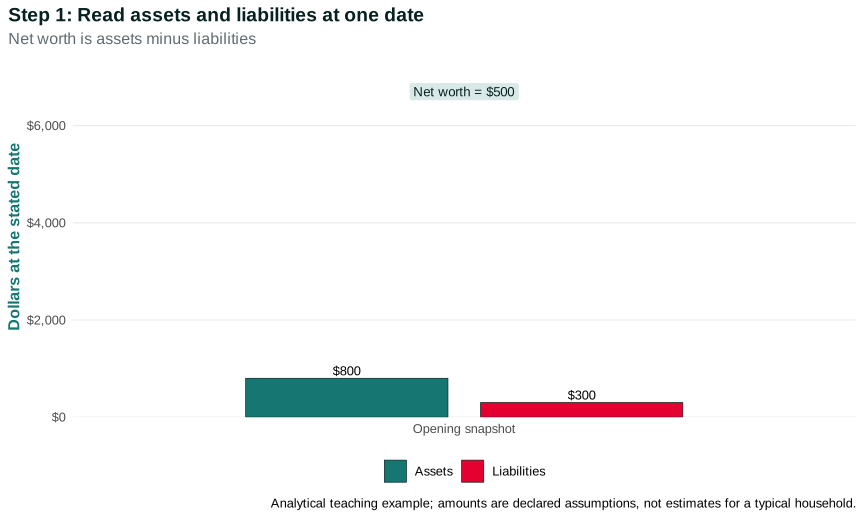
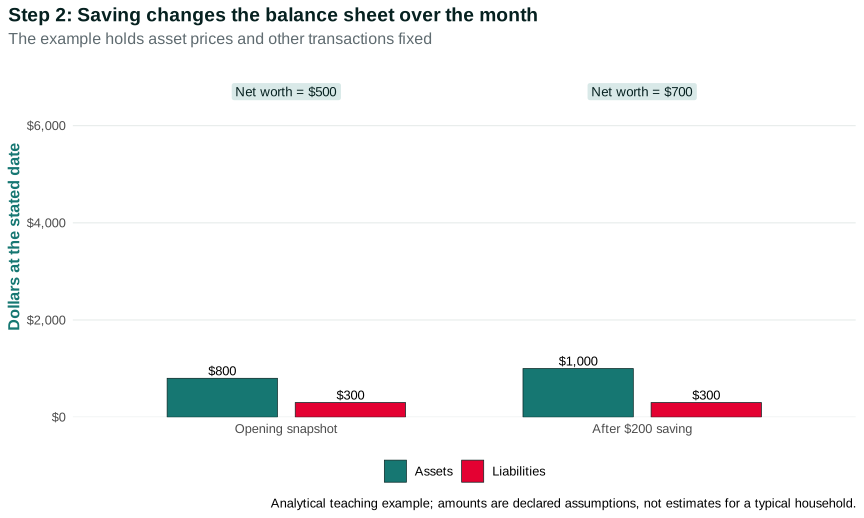
Suppose a household begins the month with $800 in a checking account, no other liquid assets, and a $300 credit-card balance. Its measured net worth from these entries is $500. If it earns $2,500, spends $2,300, and adds the remaining $200 to checking, saving during the month is $200. The end-of-month asset stock rises to $1,000. If the debt does not change, measured net worth rises to $700. The identities organize the records, but they do not explain why income, spending, or debt changed.
Liquidity adds another distinction. A checking-account balance can usually be used quickly to meet rent or repair a car. A house may be valuable but cannot normally be converted into grocery money overnight without selling or borrowing against it. Two households with the same net worth can therefore have very different abilities to absorb an emergency. One may hold liquid assets and little debt. Another may own an illiquid home while owing a mortgage and lacking cash.
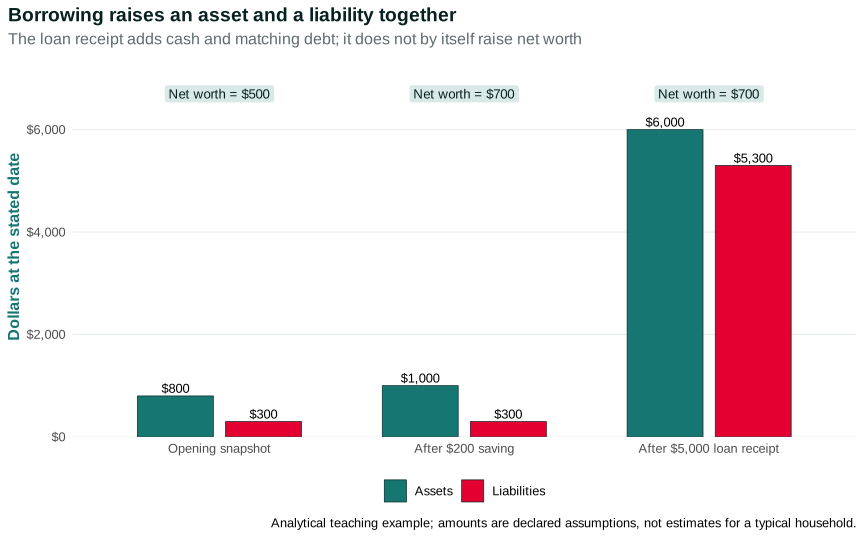
Debt is not simply negative saving. Borrowing creates an asset and a liability at the same moment. If a student borrows $5,000 and the proceeds enter a bank account, liquid assets rise by $5,000 and liabilities rise by $5,000; net worth is initially unchanged by that transaction alone. Spending the funds on tuition reduces the liquid asset, while the debt remains. Whether the transaction later raises the borrower’s economic resources depends on what the spending makes possible, the future income path, repayment terms, and risks. The accounting cannot settle that causal question.
At the economy-wide level, one party’s financial liability is generally another party’s financial asset. Adding private claims does not automatically add to the economy’s productive capacity or real wealth. A loan used to install productive equipment may help create capacity; a loan used to bid up an existing asset may mainly change ownership and prices. Chapter 13 will place banks inside these linked balance sheets and explain deposit creation. Here we stay with the borrower–lender contract and its effects on households and firms.
Wealth matters because it supplies options. Liquid wealth can cover a shock without borrowing. Collateral can make a promise more enforceable from the lender’s perspective. Ownership can generate income and provide a cushion against unemployment. Wealth also shapes bargaining power: a person who can wait or walk away from a contract has a different outside option from someone who must obtain funds today. These mechanisms help explain why class cannot be reduced to current income. Ownership, authority, wage dependence, unemployment risk, collective organization, credentials, place, and inherited resources all matter, and they intersect with race, gender, disability, and citizenship.
Source adaptation note
Source adaptation note
A balance sheet is a snapshot, but economic security unfolds through time. Suppose two households each report net worth of $20,000. One holds $20,000 in a deposit account and has no debt. The other owns a $220,000 home and owes $200,000 on a mortgage. The accounting total is the same, yet their capacity to meet a $2,000 emergency differs. The second household may be able to borrow against the home, but that depends on income, lender rules, transaction costs, and willingness to put the home at risk.
Valuation also matters. A deposit is recorded in dollars. The value of a house, business, or stock claim can change with market conditions. If an asset price falls while the liability remains fixed, net worth falls. A borrower who appeared well secured can become highly leveraged without taking a new loan. This is one route from asset-market changes to spending and credit conditions. Chapter 13 will develop the financial-system feedback, but the household mechanism begins here.
Balance sheets also reveal why money and wealth are not synonyms. A bank deposit is money for the holder and a liability of the bank. A government bond is an asset for its owner and a liability of the government. These claims can provide liquidity and security to their owners, yet adding the gross claims does not measure the economy’s stock of housing, equipment, public infrastructure, knowledge, or environmental assets. Financial wealth represents claims within an institutional system; real resources determine what the economy can produce and use.
The same framework applies to a small business. Equipment, inventories, deposits, and accounts receivable are assets. Loans and unpaid bills are liabilities. Revenue and expenses are flows. A profitable business can still fail to make a payment if revenue arrives after the obligation is due. Conversely, a business can hold cash while making losses that erode net worth. Liquidity, solvency, and profitability answer different questions.
Class position enters through this balance-sheet structure. Owners can hold assets that generate income and collateral. Workers may depend mainly on wages and face unemployment risk. A household can occupy mixed positions, such as a worker with a retirement account or a self-employed owner with little liquidity. The categories help identify mechanisms; they should not be treated as fixed personal identities that erase race, gender, disability, citizenship, place, or family obligations.
Source adaptation note
Questions
Review the live step-by-step figure
Question 12.2. What happens immediately when a person borrows $5,000 and keeps the proceeds in a bank account?
- Assets rise and liabilities rise
- Net worth rises by $5,000
- Income rises by $5,000
- Saving falls by $5,000
Exercise
Construct a balance sheet
Construct opening and closing balance sheets for a household with $1,200 in deposits, a $4,000 car, and $2,500 in debt. During the month it saves $150 and uses all of that saving to reduce debt. Show the change in assets, liabilities, and net worth, then name one important resource the table omits.
The model solution is available in the restricted instructor materials.
12.3 Moving purchasing power across time
Saving and borrowing move purchasing power in opposite directions across time. A saver gives up some consumption now in order to hold an asset that may support later consumption. A borrower gains purchasing power now and promises to give up some later. Interest is part of the price connecting these dates, but the interest rate is not the only term that matters. Fees, collateral, maturity, payment timing, penalties, and options to refinance or repay early can change the contract’s economic meaning.
Why borrow? A household may smooth consumption when income arrives irregularly. A student may finance education. A small business may buy equipment before sales revenue arrives. A family may repair a car needed to reach work. In each case, resources today may protect or expand future opportunities. But the future is uncertain. A degree may not be completed. A machine may fail. A job may disappear. An illness may raise expenses just as earnings fall.
Why lend? A household may prefer future consumption and hold a safe asset. A pension fund may need assets that support promised retirement payments. A financial intermediary may pool funds, assess borrowers, monitor repayment, and transform maturities. The macroeconomic role of finance is not merely to match two individuals. Financial institutions connect many balance sheets, direct purchasing power toward some activities rather than others, and transmit shocks when promised payments cannot be met.
The real burden of a nominal contract depends partly on prices. If a borrower promises a fixed number of dollars, unexpectedly higher inflation reduces the purchasing power of the repayment received by the lender, while unexpectedly lower inflation increases the real burden on the borrower. The relevant comparison is between the nominal interest rate and expected inflation when the contract is made. Chapter 7 introduced this borrower–lender redistribution; here it becomes one part of contract risk.
An arithmetic-first feasible-choice table can show the tradeoff without a heatmap. Suppose a person has $100 today and expects $110 next period. With no borrowing or saving, those are the feasible consumption amounts. If saving $20 today produces $21 next period, the person can choose $80 today and $131 next period. If borrowing $20 today requires $21 next period, the person can choose $120 today and $89 next period. Raising the interest rate rotates these feasible possibilities: saving yields more later, while borrowing requires a larger sacrifice later. The table describes options. It does not tell us which option a person must prefer.
Preferences are only part of the choice. A person may need food, housing, medication, or transportation now. A borrowing limit may remove desired options. Uncertainty may make a nominally affordable payment dangerous. Family responsibilities, disability-related costs, discrimination, immigration status, and place can alter both needs and contract access. Saying that someone chooses “the best available option” does not imply that the available set is fair, safe, or socially desirable.
Source adaptation note
Source adaptation note
The feasible-choice table can be extended to show uncertainty. Instead of one future income, use two possible future states: steady earnings and interrupted earnings. A fixed repayment is the same in both states, so it absorbs a larger share of income in the interrupted state. Saving today lowers current consumption but provides an asset that can be used in either future state. Insurance or an income-linked repayment rule changes which party absorbs the difference.
This is why the phrase “time preference” cannot carry the whole explanation. Someone may borrow because present needs are urgent, because a productive opportunity expires, or because expected future income is higher. Someone may save because future needs are predictable, because income is volatile, or because insurance is incomplete. Preferences matter, but so do needs, opportunities, institutions, and risk. Treating observed borrowing as a direct measure of impatience would confuse a choice with the constraints that produced it.
The interest rate changes the slope of the opportunity tradeoff, but it can also affect cash flow and selection. At a higher rate, saving one dollar produces more future dollars if the promise is honored. Borrowing one dollar requires giving up more later. For an existing variable-rate borrower, the higher rate may raise scheduled payments. For a prospective lender, the promised return rises, but so may default risk. The changed condition therefore cannot be interpreted without naming whether we are discussing a safe saving asset, a risky loan, or an existing contract.
Inflation adds a second rate. The nominal interest rate describes dollar growth. The expected real rate describes the expected growth of purchasing power. If prices rise differently from what the parties expected, the realized real burden changes. But household-specific prices can also differ from an aggregate index. A renter facing a large rent increase may experience a different budget pressure from the national inflation rate. The formula is useful only after the contract, price measure, and risk bearer are clear.
The main text should therefore move through three layers: arithmetic under certainty, a two-state uncertainty table, and one institutional change such as insurance or income-linked repayment. Optional mathematics may formalize a two-period budget line later. Students should first be able to narrate who gives up what, when, under which state, and with what recourse.
Source adaptation note
Questions
Question 12.3. An unchanged loan promises fixed dollar repayments. Who is helped by unexpectedly higher inflation?
- The lender, because the nominal payment rises
- The borrower, because the dollars repaid have less purchasing power
- Neither party, because inflation cannot affect contracts
- The borrower, because the nominal payment disappears
Exercise
Compare feasible plans
Build a three-row table for no transfer, saving $30, and borrowing $30 when a person has $150 today, expects $180 next period, and faces a one-period interest rate of 10 percent. Explain how a higher rate changes saver and borrower options without claiming which option either must select.
The model solution is available in the restricted instructor materials.
12.4 Credit contracts are incomplete
A lender would like a contract that guarantees repayment under every future circumstance. A borrower would like flexible access to funds on terms that remain manageable when circumstances change. Neither side can specify and verify everything that will happen. A contract can state a payment schedule, but it cannot fully control the borrower’s effort, business strategy, health, family needs, local labor market, or every use of funds. This is an incomplete credit contract.
Incomplete contracts create a principal–agent relationship when one party—the principal—depends on actions chosen by another—the agent, and those actions cannot be perfectly observed or enforced. In a business loan, the lender supplies funds and cares about repayment. The borrower chooses effort and risk. A high-risk project may offer the borrower a large upside if it succeeds, while part of the downside falls on the lender if limited resources make full repayment impossible. The lender may respond by screening, monitoring, requiring collateral, restricting uses, charging a higher rate, or declining the loan.
This does not mean that every borrower is tempted to behave irresponsibly or that every lender’s restriction is justified. It identifies a conflict created by information and limited liability. The same rule can have different effects across applicants. A collateral requirement may reduce the lender’s expected loss while excluding a capable entrepreneur whose family owns little wealth. A high rate may compensate for risk but also make repayment less likely. Intensive monitoring may reduce one risk while shifting time, privacy, and compliance costs onto the borrower.
Before a contract is signed, the lender may not know which applicants are safer. If a high rate discourages safer borrowers more than riskier borrowers, the applicant pool can change. After the contract is signed, choices can change risk. These pre-contract and post-contract information problems help explain why credit is often rationed rather than allocated only by raising the price. The macro implication is important: potentially productive investments can remain unfunded even when people are willing to pay a high rate.
Power is present because the lender can often define acceptable documentation, collateral, covenants, and default remedies, while the borrower decides whether to accept from a constrained set of alternatives. Consumer-protection rules, bankruptcy law, public credit programs, cooperative lending, relationship banking, and community institutions change that structure. They may improve information, pool risk, limit abusive terms, or create new problems. The relevant comparison is among institutions, not between a perfect market and a perfect government.
Source adaptation note
Source adaptation note
The principal–agent problem becomes clearer when the borrower’s project has two possible strategies. A safer strategy offers a moderate return with a high chance of repayment. A riskier strategy offers a larger upside but a greater chance that the available assets will not cover the debt. If the borrower keeps much of the upside while the lender absorbs part of the downside, the contract can encourage more risk than the lender prefers. The lender anticipates this when setting terms.
Collateral changes the payoffs. If default gives the lender a claim on an asset that the borrower values, the borrower bears more of the downside and the lender’s expected loss falls. Yet this apparent solution creates a distributional problem. An applicant with inherited assets can pledge collateral and obtain a lower-cost contract. An equally capable applicant without assets may be excluded or charged more. A rule designed to manage information and incentives can therefore transmit past wealth inequality into current investment opportunities.
Monitoring is another response. A lender may require reports, restrict how funds are used, or release funds in stages. Monitoring can reveal problems early and support advice. It can also consume time, expose private information, and give the lender authority over business choices. Standardized monitoring may work poorly for projects or communities that do not fit the lender’s categories. Relationship lending can use richer information, but relationships can also reproduce favoritism or local exclusion.
Limited liability is important because repayment cannot exceed what law and the contract permit the lender to claim. It supports entrepreneurship by limiting catastrophic personal exposure in some organizational forms. It also changes incentives because the borrower or owner may not bear the entire downside. Unlimited liability would shift more risk to the borrower but could deter valuable experimentation and concentrate opportunity among the already wealthy. Institutional design chooses a distribution of risk; it does not eliminate it.
The model’s limitation should be explicit. Real borrowers may value reputation, relationships, mission, and community effects. Lenders may have incentives to originate loans even when later losses are shifted elsewhere. Multiple lenders, guarantors, servicers, and regulators can divide information and authority. The two-actor model is a starting point for identifying hidden action and conflict, not a complete description of a modern credit system.
Source adaptation note
Questions
Question 12.4. Why might a lender decline a loan instead of continuing to raise the interest rate?
- Higher rates can change which borrowers apply and can increase repayment risk
- The lender receives no information from an application
- A higher rate removes uncertainty from the contract
- Credit contracts specify every future action
Exercise
Collateral and risk
A lender considers two applicants with identical proposed projects. One can pledge a family-owned asset; the other cannot. Explain how collateral changes expected lender loss, borrower risk, and access to credit. Identify one institutional alternative and one limitation.
The model solution is available in the restricted instructor materials.
12.5 Wealth changes credit opportunities
Suppose two people have the same current income and the same promising business idea. One owns a home and has family savings. The other rents, has student debt, and supports relatives. The first can pledge collateral, finance part of the project directly, survive a delay in revenue, and wait for better terms. The second needs a larger loan and may have to accept quickly. Equal income does not produce equal feasible choices.
Wealth affects credit through several channels. It can substitute for borrowing. It can serve as collateral. It can signal repayment capacity under existing underwriting systems. It can absorb shocks that would otherwise cause missed payments. It can support education, relocation, unpaid training, or entrepreneurship. Because wealth can be transferred across generations, credit opportunities can also be reproduced across generations.
Observed disparities require careful interpretation. If a survey shows that lower-wealth households are more likely to be denied credit or discouraged from applying, the pattern is descriptive. It may reflect collateral, income volatility, credit histories, neighborhood conditions, discrimination, product availability, application behavior, or other mechanisms. Some of those mechanisms are themselves shaped by past rules and unequal access to property, education, labor markets, and legal protection. A responsible explanation identifies evidence for particular channels rather than treating race, class, gender, or place as competing one-word causes.
Credit scores illustrate the difference between prediction and explanation. A score summarizes recorded information to predict a defined outcome. It does not measure character, effort, social worth, or the social value of a proposed investment. Records reflect past opportunities and shocks as well as choices. A model can be equally accurate on average while making different kinds of errors across groups or failing people with thin files. Lenders, regulators, and borrowers therefore care about data coverage, error, transparency, contestability, and the consequences of a decision.
Credit exclusion can protect a person from an unaffordable obligation, but it can also block a productive or protective expenditure. The economic question is not whether more credit is always better. It is whether institutions offer contracts that allocate purchasing power and risk in ways that enable valuable activity without imposing hidden or unmanageable losses. That requires attention to terms, alternatives, enforcement, insurance, and who can bear failure.
Source adaptation note
Source adaptation note
To interpret unequal credit access, separate three stages. The first is whether a person seeks credit. Some people do not apply because they do not need funds, prefer another source, expect denial, distrust the institution, cannot supply documentation, or regard the available products as unsafe. The second stage is the lender’s decision about approval, amount, price, and conditions. The third is performance after origination, which depends on the contract and later events as well as the initial applicant.
A survey category such as “discouraged from applying” is therefore economically meaningful. It records a constraint that operates before a formal denial. But it is not identical to a denial, and neither outcome proves a single mechanism. The planned SHED analysis should report them separately, use the survey weight, identify the reference group, and show uncertainty. Small subgroup cells should be suppressed or combined according to a reviewed rule rather than displayed for visual completeness.
Historical institutions help explain why current balance sheets differ. Access to property, subsidized credit, education, employment, inheritance, and legal protection has never been evenly distributed. Past exclusion can reduce collateral and credit histories today. Current discrimination can operate through treatment of equivalent applicants, through products and locations offered, or through models trained on unequal records. Establishing any one channel requires evidence matched to that mechanism.
This is also where the distinction between income and wealth matters most. Income can support payments, but wealth provides a cushion and an outside option. A high-income household with large debts and little liquid wealth may be vulnerable to a job loss. A lower-income retired household may own an asset but lack cash flow. Underwriting systems choose how to translate these dimensions into approval. Those choices can be justified as risk management and still have unequal social consequences.
Policy evaluation should examine both errors. Expanding credit can reduce exclusion while exposing some borrowers to unaffordable risk. Tightening credit can reduce defaults while blocking investment and emergency smoothing. Consumer protection, fair-lending enforcement, public guarantees, grants, community finance, and bankruptcy rules address different mechanisms. Their effects should not be collapsed into a single measure of loan volume.
Source adaptation note
Questions
Question 12.5. Why can two people with the same current income face different credit opportunities?
- Current income determines every underwriting decision
- Wealth, collateral, debt, volatility, and records can change feasible contracts
- Equal income guarantees equal net worth
- A credit score measures a person’s social worth
Exercise
Interpret a credit disparity
For the planned SHED table, identify the population, weight, outcome variable, and comparison category before interpreting a disparity in credit denial or discouragement. List two mechanisms the table cannot distinguish without additional evidence.
The model solution is available in the restricted instructor materials.
12.6 From individual contracts to the macroeconomy
Credit decisions aggregate. When many households can borrow against expected income, current consumption may rise. When firms can finance equipment, inventories, or research, investment may rise. These expenditures become income for other people and firms. Credit therefore affects aggregate demand in the short run and productive capacity over longer periods.
The feedback can also reverse. If unemployment rises, some borrowers lose income and cut spending to meet payments. Delinquencies and defaults weaken lender balance sheets. Lenders may tighten standards, which reduces new borrowing and investment. Falling asset prices can reduce collateral values, causing further contraction. Chapter 13 will develop these linked financial-sector feedbacks, including bank balance sheets, leverage, liquidity, runs, and regulation. Chapter 12 supplies the household and contract foundation.
Debt changes who bears a shock. A fixed nominal payment places more risk on the borrower when income falls. Collateral shifts loss protection toward the lender while exposing the borrower’s asset. Government guarantees may expand access while transferring some loss to taxpayers. Bankruptcy can provide insurance against catastrophic outcomes while changing lender expectations and future terms. There is no risk-free arrangement; institutions distribute risk and influence behavior.
The paradox of thrift from Chapter 6 provides another aggregation lesson. One household can increase saving by cutting spending while its income is unchanged. If many households cut spending together during a downturn, firms lose revenue, reduce production, and may cut employment. Total income can fall, making intended saving harder to achieve. That does not mean saving is individually irrational or long-run investment unimportant. It means an accounting intention becomes an aggregate outcome through spending and income feedback.
Financial intermediation can support cooperation by pooling funds, evaluating projects, diversifying risks, and providing payment services. It can also concentrate authority over which projects, places, and people receive finance. Public rules shape underwriting, disclosure, interest, bankruptcy, discrimination, data use, guarantees, and access to safe savings. These are macroeconomic institutions because they affect aggregate spending, investment, instability, and the distribution of opportunity.
Source adaptation note
The macroeconomic connection can be seen through sector balance sheets. Households hold deposits and debts. Firms hold productive assets and owe loans or bonds. Financial institutions hold loans as assets and issue deposits or other liabilities. Governments issue obligations and may guarantee private claims. A missed household payment therefore reduces cash flow to another balance sheet, and a lender’s tightening changes the feasible spending of new borrowers.
Suppose a fall in employment reduces household income. Some households draw down deposits; others borrow; constrained households cut spending. Firms receiving less revenue reduce inventories, hours, or investment. Lower income creates additional repayment stress. Lenders observe losses and tighten terms. This sequence is a behavioral feedback, not an accounting identity. Its strength depends on insurance, wealth, automatic stabilizers, lender capital, monetary policy, and expectations.
The feedback also works during expansions. Rising income and asset prices can improve measured collateral, support more borrowing, and raise spending. Stronger demand can validate optimistic expectations. But if credit growth mainly finances purchases of existing assets, prices can rise faster than productive capacity. A later reversal then damages both borrower and lender balance sheets. Chapter 13 will add leverage, maturity, liquidity, and bank money creation to this story.
Not every debt reduction is contractionary. Repayment can strengthen a household balance sheet and free later income. A lender receiving repayment can finance another activity. The aggregate effect depends on timing and on what each party does with the funds. This is why macroeconomics cannot infer total spending from one person’s prudent action without tracing the counterpart and feedback.
Public institutions can interrupt or redirect the sequence. Unemployment insurance supports income; bankruptcy restructures claims; guarantees allocate losses; central-bank facilities affect financial institutions; fiscal policy supports demand. Each intervention changes incentives and distribution. Stabilizing aggregate spending may protect borrowers and lenders while transferring risk to the public balance sheet. The relevant question is not whether risk disappears, but where it moves and under what authority.
Source adaptation note
Questions
Question 12.6. Why can tighter credit during a downturn deepen the downturn?
- Borrowers and firms may cut spending and investment, reducing other people’s income
- Credit conditions affect finance but not expenditure
- Default automatically raises collateral values
- One household’s liability is unrelated to financial assets
Exercise
Trace credit feedback
Trace a five-step feedback beginning with job loss and moving through household repayment and spending, lender standards, firm sales, and employment. At each step identify the actor adjusting and one group bearing additional risk.
The model solution is available in the restricted instructor materials.
12.7 Evaluating credit institutions
A credit institution should not be evaluated by a single outcome. Low default may reflect careful matching, strong borrower incomes, generous insurance, or exclusion of applicants who could have succeeded. High lending volume may support opportunity or may expose borrowers to harmful terms. A low interest rate may be attractive while fees, penalties, or variable payments create risk. Evaluation therefore requires several dimensions.
First, ask what activity the contract makes possible. Second, ask how total cost and payment timing compare with plausible income. Third, identify who bears unemployment, inflation, health, and asset-price risk. Fourth, examine information and decision rules: what is observed, what is missing, and how can an error be challenged? Fifth, compare access across economic positions and places. Sixth, ask what happens when many borrowers and lenders adjust at once.
Different institutions combine these dimensions differently. A private unsecured lender may provide speed but charge for risk. A credit union may use member relationships but operate at limited scale. A public loan or guarantee may expand access but require administrative capacity and transparent loss allocation. Income-contingent repayment can shift timing risk but depends on accurate income records and program stability. Grants remove repayment risk but require public financing and eligibility rules. The point is not to announce one universal winner. It is to compare goals, constraints, information, authority, scale, and distribution.
Return to the student opening the aid offer. The document is more than a price. It is a claim on future income embedded in an education system, labor market, financial system, and public policy. A useful decision combines arithmetic with uncertainty and alternatives. A useful social evaluation asks why the terms and alternatives differ, who can bear failure, and how the resulting contracts shape opportunity and aggregate stability.
A final comparison can organize credit institutions around six questions. What goal is the institution trying to achieve? What information does it use? What action or outcome can it verify? What risks does each party bear? What happens after a shock? How does the arrangement affect access across class positions and protected groups? These questions can be applied to a bank loan, federal student loan, credit union, public guarantee, grant, or informal family loan.
The comparison should include a counterfactual. If the loan is denied, what happens? The applicant may postpone the project, use a costlier product, reduce consumption, seek family support, or abandon the activity. Denial is not a neutral absence of a transaction. Approval is not automatically a gain either. The welfare comparison depends on the best feasible alternative and on outcomes under uncertainty.
Evaluation also requires a time horizon. A program may have high initial administrative cost while building information and repayment capacity. A cheap loan can become costly after a variable-rate reset. A grant can create broad benefits that do not appear on a lender’s balance sheet. Default measured in one year may miss later recovery or long-run harm. The chosen period should follow the mechanism rather than the convenience of available data.
Finally, ask who has authority to revise a mistake. Borrowers need understandable disclosures, access to records, and a way to contest errors. Lenders need enforceable promises and reliable information. Regulators need authority and capacity to detect patterns without treating every disparity as proof of misconduct. Public programs need transparent eligibility and accountable servicing. Contestability is an economic design feature because errors alter feasible choices and distribute losses.
The chapter can now return to the first loan decision with a richer answer. Arithmetic makes the promise legible. Balance sheets show capacity and vulnerability. Incomplete contracts explain screening and monitoring. Wealth and institutions explain unequal options. Aggregation shows why many individual contracts can affect demand, investment, and stability. Chapter 13 begins where this chapter ends: with the institutions whose liabilities serve as money and whose balance sheets connect credit across the economy.
One final distinction prepares that transition. A direct loan between two people moves an existing means of payment from lender to borrower. A bank loan can create a deposit while creating a matching loan asset on the bank’s balance sheet. That institutional mechanism does not mean banks can lend without constraints or that the loan creates net wealth for the private sector. Capital, liquidity, regulation, expected profitability, borrower demand, and central-bank arrangements matter. Chapter 12 should name the distinction while leaving its full development to Chapter 13.
The boundary also protects the chapter’s distributional focus. Household debt cannot be evaluated only from the consolidated financial system. A liability that nets to zero across two balance sheets can still place a vulnerable household at risk while supplying a safe asset or income stream to a wealthier holder. Aggregation does not erase positions. Macroeconomic analysis must track both the total and who holds each side of the claim.
For coauthor review, the final section should include a short return-to-objectives exercise. Students receive a contract, a household balance sheet, and a change in unemployment. They identify the accounting changes, infer no unsupported causal claim, trace the spending feedback, and compare two institutional responses. This integrated task tests whether the chapter has connected personal finance to macroeconomics rather than becoming a stand-alone financial-literacy unit.
Source adaptation note
Questions
Question 12.7. Which evaluation gives the most complete evidence about a credit program?
- Its default rate alone
- Its number of issued loans alone
- Access, purpose, total cost, risk allocation, errors, outcomes, and aggregate effects
- Its advertised interest rate alone
Exercise
Compare credit institutions
Compare a grant, fixed-payment loan, and income-contingent loan for the same educational expense. Identify the payer, recipient, repayment rule, information need, risk bearer, and one implementation problem for each.
The model solution is available in the restricted instructor materials.
Seeing the principles in action
| Principle | Example | Everyday Economics |
|---|---|---|
| Interdependence principle | A borrower’s payment is a lender’s receipt, while defaults, collateral values, and credit standards connect many balance sheets. | A missed payment can affect a household, a lender, and later applicants through changed standards. |
| Doing the best you can principle — focal | Borrowers and lenders choose among contracts subject to income, wealth, information, rules, uncertainty, and outside options. | The loan with the lowest monthly payment may not have the lowest total cost. |
| Rules of the game principle | Disclosure, underwriting, collateral, bankruptcy, servicing, and consumer-protection rules shape feasible contracts and enforcement. | The same borrower can face different options under different repayment or collateral rules. |
| Trade-offs and opportunity costs principle — focal | Borrowing expands purchasing power today in exchange for promised future resources; saving reverses that timing. | A longer loan term can lower each payment while increasing total interest. |
| Principle of gains from cooperation and conflict of interest — focal | Credit can finance mutually beneficial consumption smoothing and investment while creating conflict over information, terms, enforcement, and risk. | Collateral may make a loan possible but puts an asset the borrower values at risk. |
| Principle of individual and societal interests | Tighter lending can protect one lender while widespread tightening reduces spending and investment during a downturn. | A prudent rejection can contribute to weaker sales when many lenders react together. |
| Principle of aggregation and feedback | Income losses, defaults, collateral prices, credit standards, spending, and employment can reinforce one another across the economy. | Falling home values can weaken balance sheets and reduce borrowing even without a new job loss. |
Skills and concepts
Skills and learning objectives
- Reading a credit contract as a set of linked terms
- Distinguishing income and saving flows from assets liabilities and net worth
- Constructing and comparing feasible saving and borrowing plans
- Explaining incomplete contracts and lender-borrower incentives
- Evaluating how wealth and collateral shape credit access
- Tracing credit conditions into aggregate spending and investment
- Comparing credit institutions by access cost risk and implementation
Concepts to learn
- Principal
- Interest rate
- Loan term
- Asset
- Liability
- Net worth
- Liquidity
- Default
- Incomplete contract
- Collateral
- Credit constraint
- Balance-sheet feedback
Data literacy
When reading the planned SHED and New York Fed figures, identify the unit of observation, covered population, weight, date, balance definition, missing population, and whether the comparison is descriptive or causal. Then write one conclusion supported by the display and one tempting conclusion it cannot support.
Flashcards
Asset — something owned that provides services or future value.
Liability — an obligation owed to another party.
Net worth — assets minus liabilities at a point in time.
Liquidity — how readily an asset can meet a payment without a large loss of value.
Collateral — an asset the lender may claim under specified default conditions.
Incomplete contract — an agreement that cannot specify and enforce every relevant future action and circumstance.
Credit constraint — a limit that prevents a borrower from obtaining the desired amount or terms even when the proposed use may be valuable.
Review flags
Quantitative review is required before inserting current student-loan values, SHED estimates, or New York Fed figures. Legal and institutional review is required for current federal repayment rules. Coauthor review is required for every UTE adaptation marker. Figure production remains in R from pinned data. This feasibility draft does not authorize publication or Quarto synchronization.
Glossary
Chapter 12 terms
principal
The amount of a loan that is borrowed and remains subject to repayment, excluding interest and fees not added to the balance.
See also: interest rate; loan term.
interest rate
The interest charged or earned over a stated period as a percentage of principal; it is one contract term rather than a complete measure of cost or return.
loan term
The scheduled length of a loan, which affects payment timing and can change total interest even when principal and rate are unchanged.
See also: principal; interest rate.
asset
Something owned at a point in time that can provide services, future value, or a financial claim; how quickly it can be used depends on its liquidity.
liability
An obligation owed at a point in time, such as an unpaid loan balance or bill.
net worth
The value of assets minus liabilities at a point in time; equal net worth does not imply equal liquidity, income security, or access to credit.
liquidity
The ease and speed with which an asset can be used to make payments without a large loss of value.
incomplete contract
A credit agreement that cannot specify and enforce every relevant future event or borrower action, leaving information, monitoring, and enforcement problems.
See also: collateral; credit constraint.
collateral
An asset pledged to a lender that can increase recovery after default while shifting additional loss risk to the borrower.
See also: incomplete contract; credit constraint.
credit constraint
A limit on the amount or terms of borrowing available to an actor, including denial when no feasible contract is offered.
See also: collateral; incomplete contract.
Flashcards
Why is a low monthly loan payment not enough to identify a low-cost contract?
The principal, rate, term, fees, payment rule, and total repayment must be considered together.
What happens to net worth when cash and an equal loan liability rise together?
The transaction alone leaves net worth unchanged because assets and liabilities rise by the same amount.
Why is a credit contract incomplete?
It cannot specify and enforce every future event or borrower action that affects repayment.
How can a credit contraction create macroeconomic feedback?
Reduced borrowing, spending, and investment lower sales and income, weakening more balance sheets and tightening credit further.