How the Federal Reserve Works

Public working draft: This AI-assisted feasibility draft is open for coauthor revision. Institutional descriptions, empirical claims, policy judgments, and figure rights remain subject to human review. The chapter describes the operating framework as of August 2026; current official sources must be checked again before an approved publication snapshot.
Central question: Who makes a Federal Reserve monetary-policy decision, how is that decision implemented in today’s ample-reserves system, and how is delegated authority made accountable?
By the end of this chapter, you should be able to: distinguish a monetary-policy decision from its implementation; identify the roles of Congress, the Board of Governors, the Federal Open Market Committee, the twelve Reserve Banks, and the New York Fed’s Open Market Trading Desk; explain reserve balances and the federal funds market with linked balance sheets; explain why interest on reserve balances is the main implementation tool in an ample-reserves system; distinguish the overnight reverse repurchase facility from IORB; trace a securities purchase through the Federal Reserve’s balance sheet; compare limited- and ample-reserves frameworks; and evaluate claims about central-bank independence, accountability, and distribution without confusing operational control with control over inflation.
11.1 What happens on an FOMC announcement day?
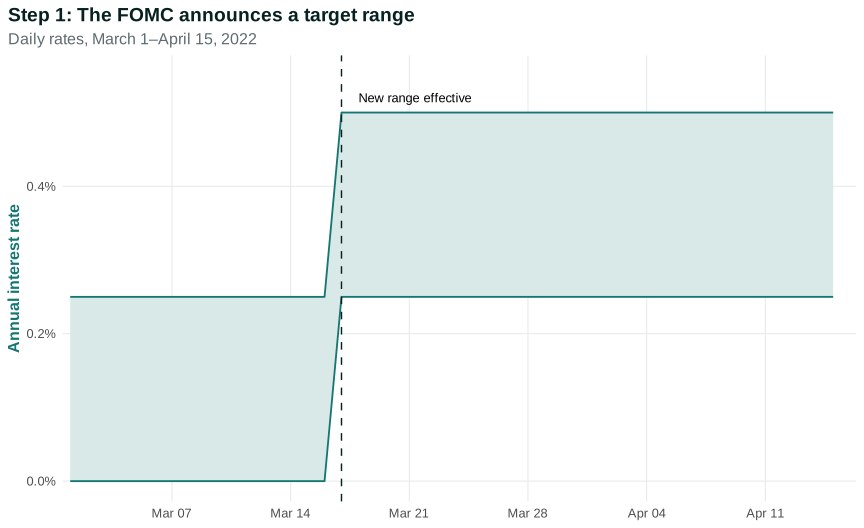
At 2:00 p.m. Eastern time on March 16, 2022, the Federal Open Market Committee released a statement. It described employment as strengthening and inflation as elevated, referred to the uncertainty caused by Russia’s invasion of Ukraine, and announced a target range of 0.25 to 0.50 percent for the federal funds rate. Eight members voted for the action. One member preferred a larger increase. March 2022 FOMC statement
That statement was a decision about the stance of monetary policy. It did not order every bank to lend overnight at 0.25 or 0.50 percent. It did not set a mortgage rate. It did not move money mechanically from the Federal Reserve into household checking accounts. It announced a target for a market rate and explained why the committee thought the change was appropriate.
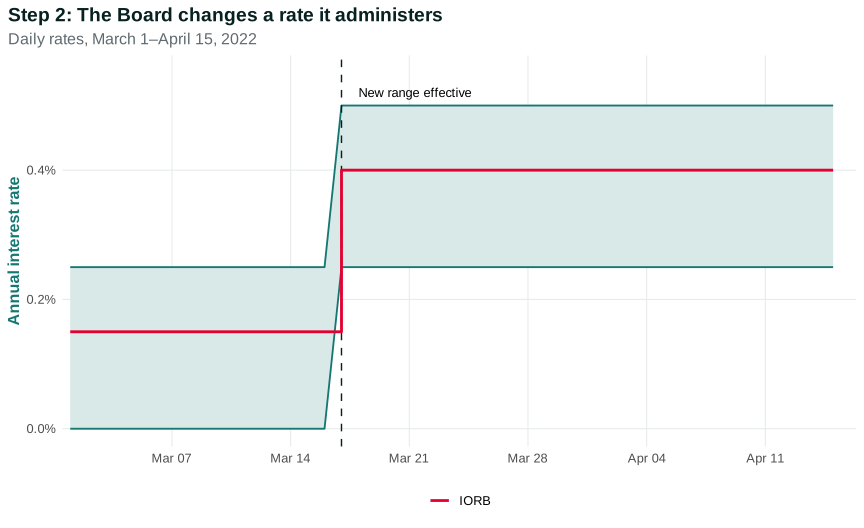
On the same day, a separate implementation note identified concrete actions. The Board of Governors voted to set the interest rate paid on reserve balances at 0.40 percent, effective the next day. The FOMC directed the Open Market Trading Desk at the Federal Reserve Bank of New York to conduct operations as needed to maintain the federal funds rate within the new range and set an overnight reverse-repurchase offering rate of 0.30 percent. March 2022 implementation note
The two documents assign different verbs to different institutions. The FOMC decided on a target range. The Board set an administered rate. The FOMC directed the Desk. The Desk executed transactions. Private institutions then traded in an overnight market. Treating all of these actions as “the Fed set interest rates” hides the mechanism and the division of authority.
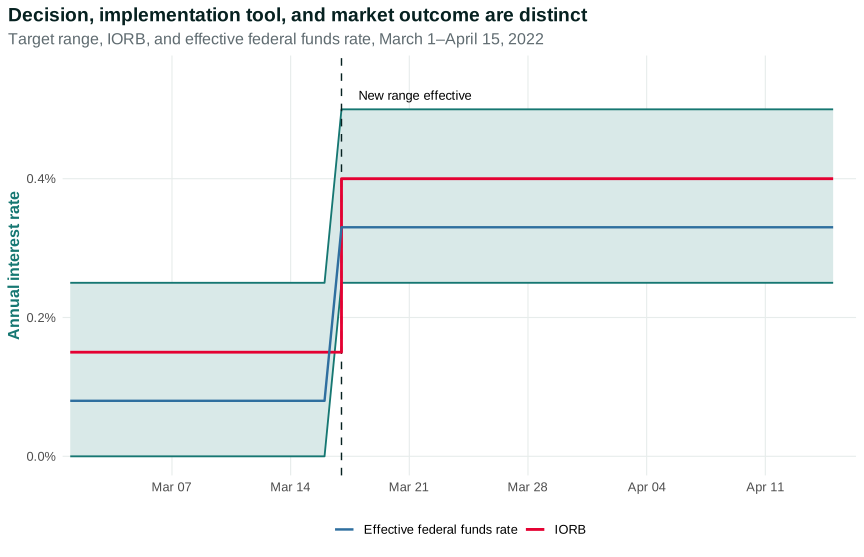
Figure 11.1 compares the announcement with the market outcome. Step 1 teaches the shaded target range. Step 2 adds the administered IORB rate. The summary adds the effective federal funds rate, a daily statistic constructed from actual overnight transactions.
Open the live step-by-step figure
Begin with the axes. The horizontal axis covers only six weeks, so the figure is an announcement-window description rather than a long-run evaluation. The vertical axis reports annualized percentage rates, although the underlying loans are overnight. The shaded area is a policy range, not observed transactions. The effective rate is observed market evidence; the IORB line is an administratively chosen rate.
Now compare named dates. Before March 17, the range was 0 to 0.25 percent and IORB was 0.15 percent. On March 17, the range became 0.25 to 0.50 percent and IORB became 0.40 percent. The effective rate moved from 0.08 percent on March 16 to 0.33 percent on March 17. It remained within the range during the plotted weeks. That is evidence that the operating system successfully moved its immediate market target.
It is not evidence that the rate increase caused any particular later path for inflation, output, or employment. Chapter 10 showed the longer chain through expected rates, market yields, credit terms, household and firm choices, aggregate demand, and employment. Chapters 7 and 8 showed that inflation can reflect demand, supply, expectations, distributional conflict, and lagged contracts. Operational success at the first link is therefore neither a proof that the policy decision was wise nor a demonstration that the entire macroeconomic transmission chain worked exactly as intended.
The memorable pattern is narrower but important: a committee announcement, an implementation note, an administered rate, and a market rate lined up as distinct parts of one process. That pattern leads to the chapter’s question. Who makes each Federal Reserve decision, how do reserve accounts and administered rates make the target operational, and how is this delegated power made accountable?
Questions
Review the live step-by-step figure
Question 11.1. What does Figure 11.1 establish?
- The FOMC directly set every overnight transaction rate
- The target decision, IORB setting, and EFFR were distinct but aligned parts of implementation
- The rate increase caused later disinflation by itself
- Mortgage rates must equal IORB
Exercise
Decision and implementation
Use Figure 11.1 and the March 2022 documents to identify the institution, action, date, and measure for the target range, IORB, and EFFR. State one conclusion the evidence supports and one it does not.
The model solution is available in the restricted instructor materials.
11.2 A system, not one bank
The name Federal Reserve System is a clue. It is not a single bank with a single decision-maker. Congress created a public institution with a national Board of Governors, twelve regional Federal Reserve Banks, and a Federal Open Market Committee that combines members from both. Its hybrid design distributes information and authority while also creating recurring questions about representation and accountability. Federal Reserve structure
The Board of Governors is a federal agency in Washington, DC. It is designed to have seven members. The President nominates governors and the Senate confirms them. Long, staggered terms are intended to reduce the dependence of monetary policy on a single election cycle. The President separately designates, and the Senate confirms, the Chair and Vice Chair from among the governors. The Board supervises the Reserve Banks, sets certain administered rates such as IORB, and carries statutory responsibilities in supervision, payments, consumer protection, and financial stability.
The twelve Federal Reserve Banks are regional operating institutions. Their districts reflect economic and political compromises made when the system was established, not the present distribution of population or economic activity. They provide payment and banking services to eligible institutions and the US Treasury, hold reserve accounts, make certain loans, gather regional information, conduct research, and participate in monetary policymaking. They do not provide ordinary checking accounts to households.
Each Reserve Bank has a president and board of directors under a structure set by law. Commercial member banks select some directors; the Board of Governors appoints others. Directors have roles in Reserve Bank oversight, but banking representatives do not select Reserve Bank presidents in the simple way a corporate board selects a chief executive. Current law and Board policy limit which director classes participate in that appointment and require Board approval. The details matter because the regional banks combine public purposes with institutional input from finance, business, labor, community, and other constituencies.
The Federal Open Market Committee—usually shortened to FOMC—is the monetary-policy decision-making body. Its voting members are the members of the Board of Governors, the president of the Federal Reserve Bank of New York, and four presidents from the other eleven Reserve Banks serving on a rotating basis. All twelve Reserve Bank presidents attend and participate in the discussion, even when they do not vote. The Chair of the Board chairs the FOMC; the New York Fed president is the committee’s vice chair.
The Federal Reserve Bank of New York has a distinctive operational role. Its Open Market Trading Desk conducts transactions for the System Open Market Account under FOMC directives. It also calculates and publishes the effective federal funds rate from transaction data. The New York Fed does not independently choose the national monetary-policy stance. It implements instructions within an institutional framework and reports market information back into policymaking.
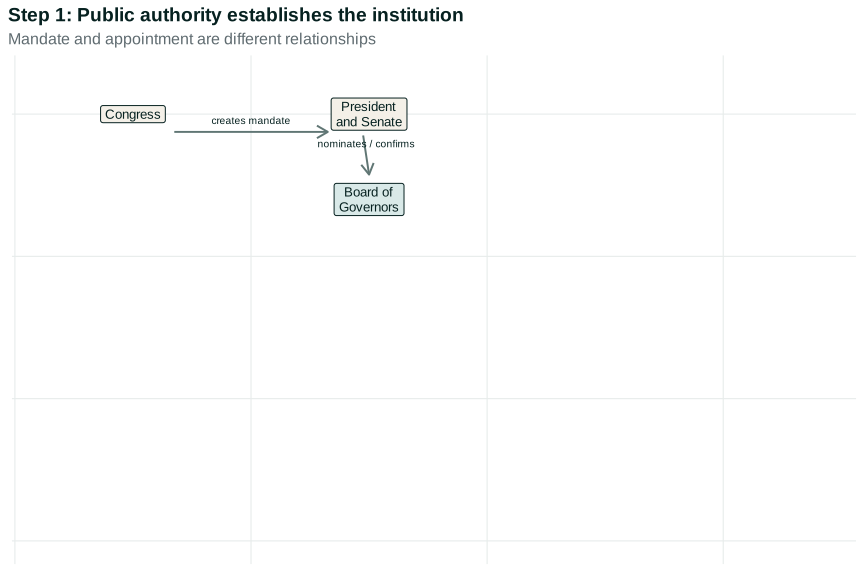
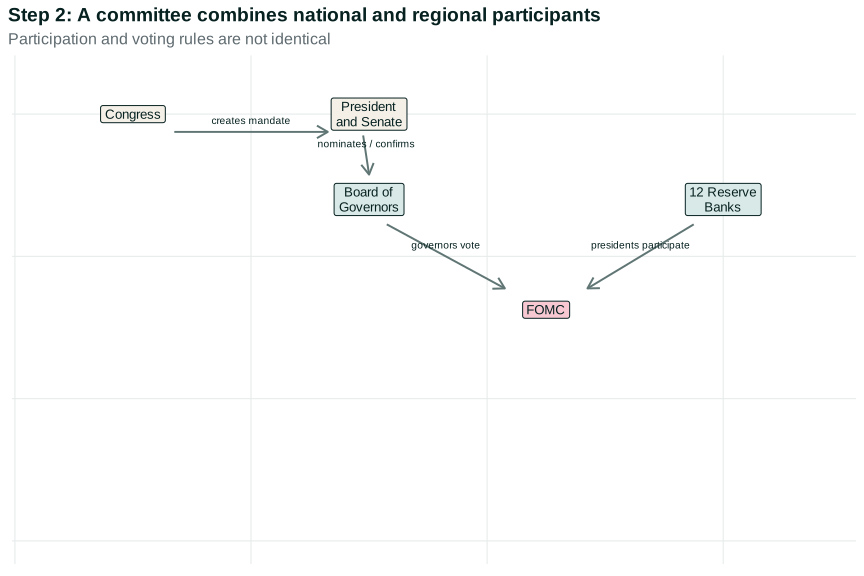
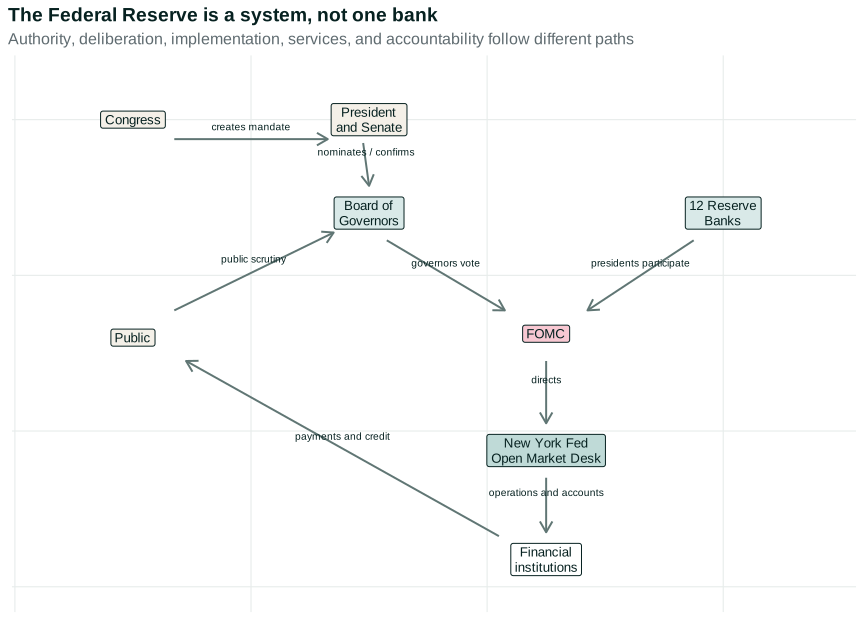
Figure 11.2 builds the system in three steps.
Open the live step-by-step figure
Do not read every arrow as the same relationship. Congress establishes legal goals and can amend the Federal Reserve Act. The President nominates governors; the Senate confirms them. Governors and Reserve Bank presidents deliberate in the FOMC under different voting rules. The FOMC directs the Desk; the Board sets IORB; Reserve Banks maintain accounts and services. Reports, testimony, minutes, data, audits of appropriate functions, and public explanation run in the accountability direction.
This structure can produce disagreement without institutional failure. In March 2022, the dissenting voter preferred a larger increase, not no action. Publishing the vote told the public that the target range was a collective judgment under uncertainty rather than an automatic output of a formula. Regional information can broaden the evidence available to the committee, but regional representation is not the same as one-person-one-vote democracy. A central bank is a delegated public authority, not a legislature.
The Rules of the game principle is central here. Appointment rules, voting rotation, legal mandates, meeting procedures, access to reserve accounts, counterparty eligibility, and disclosure requirements shape who can act and which choices are feasible. These rules do not merely surround monetary policy. They constitute the institution that conducts it.
The system map tells us who acts. It does not yet tell us why society delegates this authority or how independence can coexist with democratic control. That is the next problem.
Questions
Review the live step-by-step figure
Question 11.2. Which institution conducts authorized open-market transactions for the System Open Market Account?
- Congressional Budget Office
- New York Fed Open Market Trading Desk
- Every Reserve Bank independently
- US Treasury alone
Exercise
Follow the authority
Choose one arrow in Figure 11.2 and explain why appointment, voting, implementation, or oversight would be an inaccurate substitute for its actual label.
The model solution is available in the restricted instructor materials.
11.3 Mandate, independence, accountability, and transparency
Congress has assigned the Federal Reserve long-run monetary-policy objectives that are commonly summarized as maximum employment and stable prices. Congress has also provided operational independence: elected officials establish the goals and legal powers, while the FOMC can adjust its instruments without obtaining approval from the President or Congress for every meeting decision. Legal framework for monetary policy
Central-bank independence is therefore not independence from law, evidence, public criticism, or consequences. It is a particular allocation of decision authority. One rationale is time horizon. A government facing an election might value a short-lived expansion even when it risks later inflation or financial instability. Longer terms and instrument autonomy can make it easier for policymakers to act on a longer horizon. Specialization is another rationale: monetary-policy implementation requires staff, market infrastructure, data, and repeated technical judgment.
But delegation creates an agency problem. Officials with public power may make mistakes, give excessive weight to financial-market perspectives, communicate in language inaccessible to the public, or distribute costs in ways that are politically consequential. Independence cannot answer the normative question of whose risks count. It must be paired with accountability: obligations to explain decisions, disclose evidence and disagreement, operate within legal authority, appear before elected representatives, and remain subject to institutional review.
Accountability occurs on several clocks. On the meeting day, the FOMC publishes its decision, vote, and a concise explanation. The Chair normally holds a press conference. When scheduled, participants publish economic projections, but those projections are not a collectively promised policy plan. Minutes arrive later and provide more detail about the range of views. Transcripts are released with a much longer delay. The Chair testifies before Congress, the Board publishes reports and financial statements, and the institution releases extensive operational data.
Each document answers a different question. The statement records what the committee decided and why it chose to emphasize particular considerations. The implementation note records operational instructions. Minutes reveal the discussion in greater depth but are written after the meeting. Projections show individual participants’ conditional outlooks, not a vote on one interest-rate path. Later data revisions can change what historians know about the economy without changing what policymakers knew at the time.
This timing matters when evaluating a decision. Suppose a later employment revision shows the labor market was weaker than first reported. That evidence may alter an ex post assessment, but it would be unfair to claim that policymakers ignored data unavailable to them. Conversely, uncertainty does not excuse every error. An accountable evaluation asks what information was available, what alternatives were considered, which risks were recognized, and whether later learning changed the framework.
Transparency is not measured by document volume alone. A thousand pages can remain inaccessible. Effective transparency allows different audiences to identify the decision, responsible actor, reasoning, uncertainty, and mechanism. The March 2022 statement and implementation note are useful together precisely because they separate the policy choice from the tools. A press conference can clarify this division or blur it by describing every action as “the Fed.”
Independence and accountability also have distributional stakes. Raising rates can reduce demand and inflation pressure while increasing unemployment risk and new borrowers’ payments. Paying interest on reserve balances sends income to eligible institutions, while the Federal Reserve earns income on securities and bears expenses and potential accounting losses. Asset purchases can change yields and asset values. Emergency facilities determine which institutions receive liquidity against what collateral. These consequences do not prove a policy is wrong, but they create legitimate demands for explanation and oversight.
Representation affects knowledge and legitimacy. Workers, tenants, small firms, community banks, large financial institutions, and asset managers experience the same policy differently. The Federal Reserve gathers information through regional contacts, advisory councils, surveys, hearings, and research, but access to policymakers is unequal. Expertise can protect decision quality while also narrowing which experiences are treated as evidence. Public accountability includes asking whose information enters the forecast.
There is no simple equation that determines the ideal degree of independence. Too little insulation can make policy subordinate to immediate partisan goals. Too much insulation without credible accountability can weaken legitimacy and allow institutional blind spots. The design problem is to combine delegated discretion with a clear mandate, transparent reasoning, diverse information, legal limits, and review.
The Principle of gains from cooperation and conflict of interest helps organize the issue. Stable payments, credible institutions, and lower macroeconomic volatility can create widespread gains. But disagreements remain about acceptable inflation, employment risk, asset-price effects, fiscal interactions, and the distribution of adjustment costs. Institutional cooperation does not erase conflict over outcomes.
This discussion tells us why the committee has authority and how it can be evaluated. We now need the asset that sits at the center of day-to-day implementation: a reserve balance.
Questions
Question 11.3. Operational independence means…
- the Federal Reserve is outside US law
- the FOMC needs presidential approval at every meeting
- authorized instruments can be adjusted without approval for every decision, alongside accountability
- distributional consequences need not be explained
Exercise
Evaluate accountability
Design a five-item evidence checklist for evaluating an FOMC decision using information available on the meeting date and information learned later.
The model solution is available in the restricted instructor materials.
11.4 Reserve balances, payments, and the federal funds market
A reserve balance is a deposit that an eligible institution holds in an account at a Federal Reserve Bank. On the commercial bank’s balance sheet, the reserve balance is an asset: the Federal Reserve owes it to the bank. On the Federal Reserve’s balance sheet, the same amount is a liability. It is not currency in a bank vault, a household deposit, bank capital, or a pile of loanable cash waiting to be handed to a borrower.
Reserve balances help banks settle payments. Consider Maya, who has a deposit at Harbor Bank, and Luis, who sells her a used car and banks at Valley Bank. Maya sends Luis $8,000. The simplified payment changes the two banks’ balance sheets as follows:
| Position | Harbor Bank | Valley Bank | Entire banking system |
|---|---|---|---|
| Customer deposits | −$8,000 Maya | +$8,000 Luis | No change |
| Reserve balances | −$8,000 | +$8,000 | No change |
Harbor Bank reduces Maya’s deposit and transfers $8,000 of reserve balances through the Federal Reserve’s payment system. Valley Bank receives reserves and credits Luis’s deposit. The payment redistributes both deposits and reserves between banks. It does not, by itself, change the aggregate amount of either in this simplified example.
This is an accounting result, not a complete behavioral model. Harbor Bank may prefer more reserves because it expects additional payments, wants a liquidity buffer, faces internal risk limits, or must satisfy regulatory ratios. Valley Bank may be willing to lend some funds overnight, hold them at the Fed, buy another asset, or adjust another liability. Each institution compares expected returns, liquidity, risk, regulation, and counterparty relationships.
The federal funds market is a market for overnight, unsecured borrowing and lending of balances held at Federal Reserve Banks among eligible institutions. “Unsecured” means the loan is not backed by pledged collateral. The negotiated rates on transactions vary. The New York Fed reports the effective federal funds rate, or EFFR, as a volume-weighted median of eligible transactions from the previous business day.
The FOMC does not dictate each transaction rate. It announces a target range for the federal funds rate. Implementation succeeds when administered rates, reserve conditions, standing facilities, arbitrage, and market behavior keep the EFFR well within that range. The distinction between a target and an observed rate is the same distinction students saw in Figure 11.1.
Why borrow overnight if the system as a whole already has ample reserves? Because aggregate abundance does not imply that every institution has the same balance at every moment or values an additional dollar equally. Payments move balances. Some eligible lenders—historically including government-sponsored enterprises—may not receive IORB. Banks differ in business models, regulations, internal limits, relationships, and access to other markets. The federal funds market can be small relative to the banking system and still provide a useful policy-rate measure.
Now change one condition at a time. First, suppose Harbor Bank expects a large outgoing payment tomorrow. Its desired reserve buffer rises. It may borrow, sell another liquid asset, attract deposits, or reduce lending in another market. Second, suppose the return on holding reserves rises. Eligible banks compare overnight private loans with a safer IORB return. Third, suppose market stress increases uncertainty about counterparties. A bank may demand a higher rate or refuse to lend even if the average level of reserves is unchanged.
The payment table also prevents a common aggregation mistake. One bank can acquire reserves from another bank; all banks together cannot increase aggregate reserve balances merely by trading among themselves. Aggregate reserves change when the Federal Reserve changes its assets or other liabilities, or when transactions involving items such as currency and the Treasury’s account alter the residual reserve supply. Chapter 6 used a similar discipline: one actor’s spending is another actor’s income, while economy-wide feedback requires tracking the whole system.
Bank lending to households and firms is a different transaction. A bank can make a loan by crediting a borrower’s deposit account, expanding both an asset and a liability on its balance sheet. Whether it does so depends on the expected return, borrower creditworthiness, collateral, capital, liquidity, funding, regulation, and demand for credit. It later needs to settle resulting payments and manage its liquidity, but no fixed reserve fraction mechanically determines a fixed multiple of loans. Banks, reserves, and the curriculum gap
This is why the old mechanical money-multiplier story is misleading in today’s framework. It turns a balance-sheet relationship into a behavioral law and puts reserve quantity at the center of interest-rate control even though administered rates are the main tool. Chapters 12 and 13 will examine bank lending, money creation, capital, liquidity, and runs more fully. Here the key lesson is narrower: reserves are settlement assets and Federal Reserve liabilities, and their price in overnight markets is steered through an ample-reserves operating system.
Questions
Question 11.4. Maya pays Luis at another bank. What changes for the banking system in the simplified table?
- Aggregate reserves necessarily rise
- Aggregate deposits necessarily fall
- Reserves and deposits move between banks while their system totals are unchanged
- Federal Reserve assets automatically rise
Exercise
Settle a payment
Extend the Maya–Luis table to a $2,000 payment from a Valley Bank customer to a third bank. Show bank deposits, reserve balances, and the system totals before explaining one omitted behavioral response.
The model solution is available in the restricted instructor materials.
11.5 Implementing policy with ample reserves
An ample-reserves framework supplies enough reserve balances that small changes in their aggregate quantity usually have little effect on the federal funds rate. In that region, the Federal Reserve controls short-term rates primarily by changing administered rates rather than by fine-tuning reserve supply every day. Wolla and Ihrig ample-reserves teaching sequence
The main administered rate is interest on reserve balances, abbreviated IORB after its first use. It is the rate the Federal Reserve pays on balances maintained by or for eligible institutions in master accounts at Reserve Banks. The Board of Governors sets the rate. For an eligible bank, holding one more dollar in its reserve account provides a safe, liquid overnight return.
Suppose a bank can earn 4.40 percent at the Fed or lend overnight to a private counterparty at 4.10 percent. If the transactions have comparable timing but the private loan adds risk and operating cost, the bank has little reason to accept the lower rate. It may instead hold reserves or seek to borrow at the low market rate and earn IORB, subject to balance-sheet costs, regulation, credit limits, and market access. These choices put upward pressure on private overnight rates.
This explanation begins with a feasible choice, not a curve. The bank has goals—return, safety, liquidity, and regulatory compliance—and constraints—counterparty access, capital, leverage rules, internal limits, and transaction costs. Raising IORB changes one outside option. Banks revise bids and offers. Market rates adjust. Because frictions differ across institutions, the EFFR need not equal IORB exactly.
IORB is not available to every important money-market participant. Money market funds, for example, cannot simply hold an interest-bearing reserve account as a bank can. The Federal Reserve therefore uses the overnight reverse repurchase agreement facility, or ON RRP facility, as a supplementary tool. Eligible counterparties can place cash overnight with the Federal Reserve against Treasury collateral and receive a stated return. The facility gives a broader set of institutions a safe alternative, helping limit downward pressure on overnight rates.
The names can obscure the direction of the transaction. From the Federal Reserve’s perspective, it sells a security overnight and agrees to buy it back—hence “reverse repurchase agreement.” From the counterparty’s perspective, it places cash at the Fed overnight and receives collateral. The key economic idea is an outside option with defined eligibility and return. The full market plumbing matters for specialists, but a first-year student should first understand who can use the option and how it affects bargaining.
Three institutions receive the same rate news
Consider a bank, a government money market fund, and a securities dealer after the target range rises by one-quarter percentage point. The bank is eligible to earn IORB. Its treasury desk compares that new return with an unsecured overnight loan, a secured repo loan, and the value of keeping an immediately available payment buffer. The IORB change does not command one choice, but it raises the return against which those choices are evaluated.
The money market fund is not eligible for IORB. It gathers cash from shareholders and invests in short-term instruments subject to legal, liquidity, and risk constraints. If it is an approved ON RRP counterparty, the facility gives it another overnight choice. Raising the ON RRP offering rate can strengthen the fund’s bargaining position when it negotiates private repo or purchases short-term securities. The fund cannot carry out the bank’s IORB strategy because the rules of access differ.
The dealer may need cash to finance securities inventory. It compares private repo rates with the Standing Repo Facility if it is eligible and has suitable collateral. Its borrowing need can rise when Treasury issuance or customer trading increases. A higher ceiling-like backstop does not mean the dealer automatically uses it; stigma, procedures, collateral, private relationships, and relative pricing matter.
Now aggregate cautiously. The bank may demand more funds in one market, the money fund may refuse low private offers, and the dealer may bid more for secured financing. Those adjustments help move overnight rates, but they occur in several connected markets with different participants. The EFFR summarizes eligible unsecured federal funds trades, not all overnight funding. Other rates—such as repo rates—provide additional evidence about implementation and scarcity.
This actor-by-actor sequence follows a lesson emphasized in recent teaching work by Jane Ihrig and Scott Wolla: students should learn the FOMC’s target decision, the ample quantity of reserves, and the administered-rate tools as separate but connected ideas. Acronyms come after the economic roles. Once students can say “which institution has which safe alternative,” IORB and ON RRP become useful compact labels rather than vocabulary obstacles.
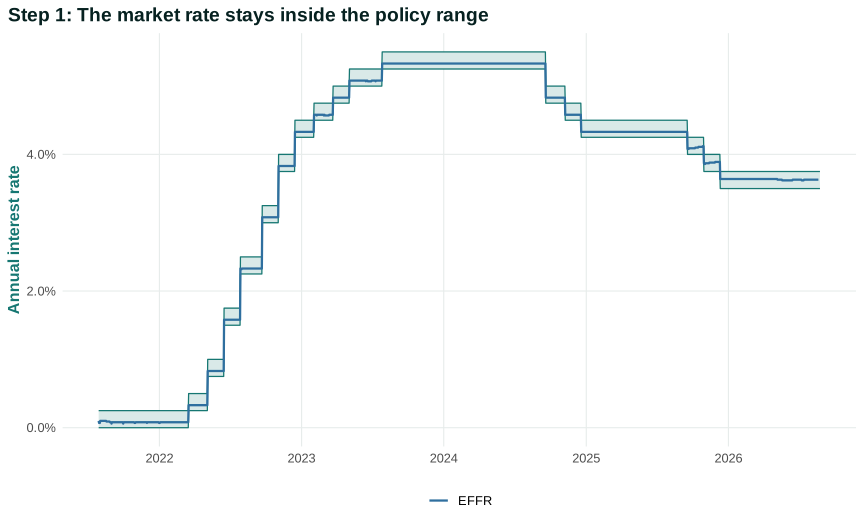
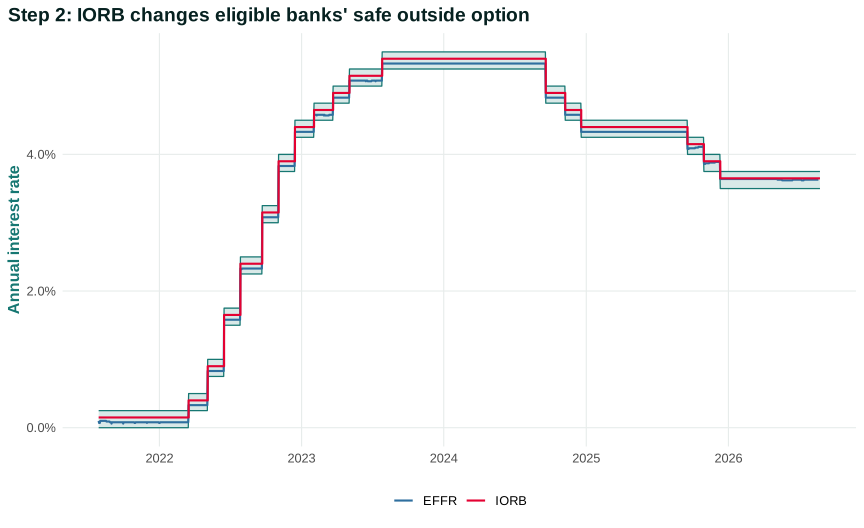
Figure 11.3 teaches the operating range with actual rates since the unified IORB series began in 2021.
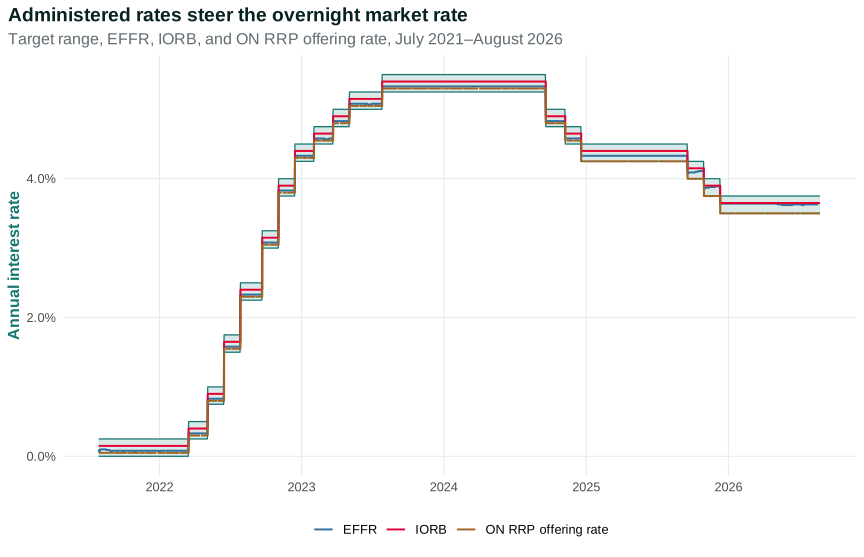
Open the live step-by-step figure
Read the target range before the individual lines. Then compare the EFFR with IORB. Finally add ON RRP, whose eligible counterparties differ. The close movements show effective rate control over several tightening and easing decisions. They do not prove that every financial institution had the same opportunity, that arbitrage was costless, or that inflation and employment followed a mechanically selected path.
Why can the EFFR sometimes sit below IORB? Some lenders in the federal funds market may not earn IORB. A bank that can borrow from such an institution and hold reserves at the Fed may share part of the rate difference, but balance-sheet costs, bargaining, credit limits, and relationships prevent the gap from disappearing completely. “Arbitrage” here means responses to return differences; it does not mean a free, unlimited profit available to every student with a phone.
The ON RRP rate can strengthen the outside option of eligible nonbanks. If a money market fund can place cash at the facility, it is less willing to accept a much lower private overnight rate, other things equal. Access rules therefore affect bargaining power. A floor is not a concrete slab under every transaction; it is the result of institutions having alternatives and acting on them with frictions.
Facilities on the upper side of money markets provide backstops against sharp upward pressure. The discount window lets eligible depository institutions borrow from a Reserve Bank against collateral. The Standing Repo Facility offers overnight financing against eligible securities to approved counterparties. These facilities have distinct eligibility, collateral, and pricing rules. Their presence can influence choices even when usage is low, much as an available outside option changes bargaining without being chosen every time.
Change the policy stance by one condition. If the FOMC raises the target range and the Board raises IORB while the FOMC raises relevant facility rates, safe outside options move upward. Eligible institutions revise the minimum rates they will accept or the maximum rates they will pay. Overnight market rates move upward. The quantity of reserves need not fall for the EFFR to rise. A lower-rate decision reverses the logic.
Now hold the stance fixed and change reserve conditions. If reserves remain ample, a modest payment-driven change in supply should have little effect on the EFFR. If reserves become too scarce relative to institutions’ demand, rates and volatility can rise, and the Desk may need operations that add reserves. The September 2019 money-market episode illustrated that reserve distribution, regulation, tax payments, Treasury settlements, and risk management can generate pressure even when aggregate reserves appear large by historical standards.
This framework does not make the quantity of reserves irrelevant. It changes its job. The quantity must be sufficient to keep the system in the ample region; administered rates then do most of the day-to-day work of steering short-term rates. The Federal Reserve must monitor money-market spreads, payment flows, facility use, and reserve demand because the boundary of “ample” is not a fixed dollar number.
Nor does IORB directly order banks to lend more or less to households. A higher IORB rate changes one bank asset’s return and helps move broader short-term rates. Chapter 10’s transmission chain then works through expected rates, yields, credit terms, spending, employment, and pricing. A bank may increase, decrease, or rearrange lending depending on customers, risk, capital, funding, and expected returns. The mechanism is a price-and-choice chain, not a reserve-to-loan conveyor belt.
The distributional question is real. IORB payments go to eligible institutions holding reserve balances; ON RRP returns go to eligible counterparties. The Federal Reserve also earns interest on its securities and pays operating expenses, with net earnings or deferred assets affecting remittances to the Treasury over time. Evaluating the arrangement requires tracking both sides of the public balance sheet and the alternative implementation frameworks—not simply labeling all interest payments a transfer with no policy purpose or assuming their incidence is irrelevant.
The Interdependence principle appears at the first step of policy. Administered rates, private overnight markets, reserve holdings, Treasury flows, regulations, and facilities affect one another. Implementation works because institutions respond to linked opportunities, not because the central bank announces a number by itself.
To see where the reserves and interest payments appear, we next open the Federal Reserve’s balance sheet.
Questions
Review the live step-by-step figure
Question 11.5. Why does IORB put upward pressure on overnight market rates?
- It legally fixes every trade at the IORB rate
- It gives eligible banks a safe return they can compare with private lending
- It is available directly to every household
- It mechanically multiplies reserves into loans
Exercise
Compare outside options
Suppose IORB is 4.40 percent, ON RRP is 4.30 percent, and an overnight private loan offers 4.10 percent. Compare the feasible choices of an eligible bank and an eligible money market fund, then name two frictions that complicate the prediction.
The model solution is available in the restricted instructor materials.
11.6 The Fed balance sheet and reserve management
A central-bank balance sheet records assets the Federal Reserve owns or is owed and liabilities it owes to others. Important assets include Treasury securities, agency mortgage-backed securities, and loans. Important liabilities include currency in circulation, reserve balances, the Treasury General Account, and reverse-repurchase agreements. Capital is recorded separately. The two sides must balance as an accounting identity.
Start with a deliberately simplified balance sheet:
| Federal Reserve | Assets | Liabilities |
|---|---|---|
| Treasury securities | $100 | Reserve balances |
| Loans and other assets | $10 | Currency and other liabilities |
| Capital | ||
| Total | $110 | Total |
Suppose the Desk buys $10 of Treasury securities from a dealer whose bank settles the transaction. The Federal Reserve’s Treasury assets rise by $10 and reserve liabilities rise by $10. The selling investor exchanges a Treasury security for a deposit or another liquid claim; the bank receives reserves and owes the corresponding customer deposit. No truck delivers paper dollars. Entries change on connected balance sheets.
Figure 11.4 follows the transaction and then changes the purpose.
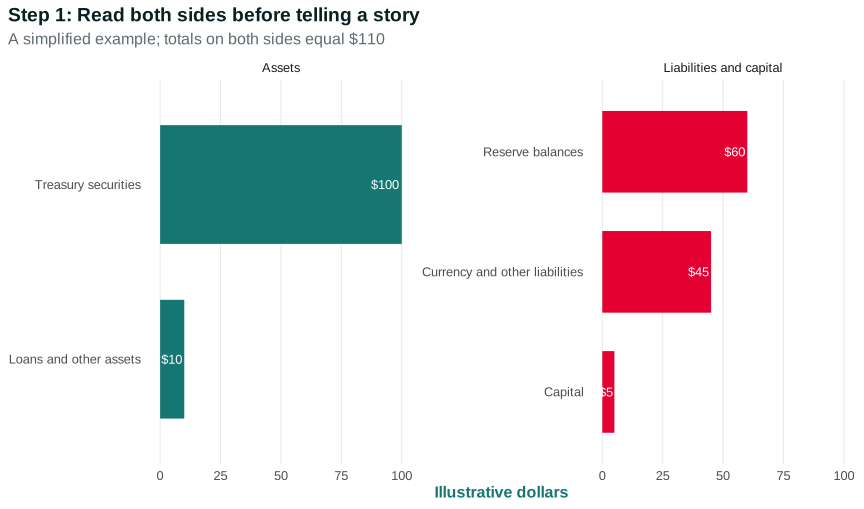
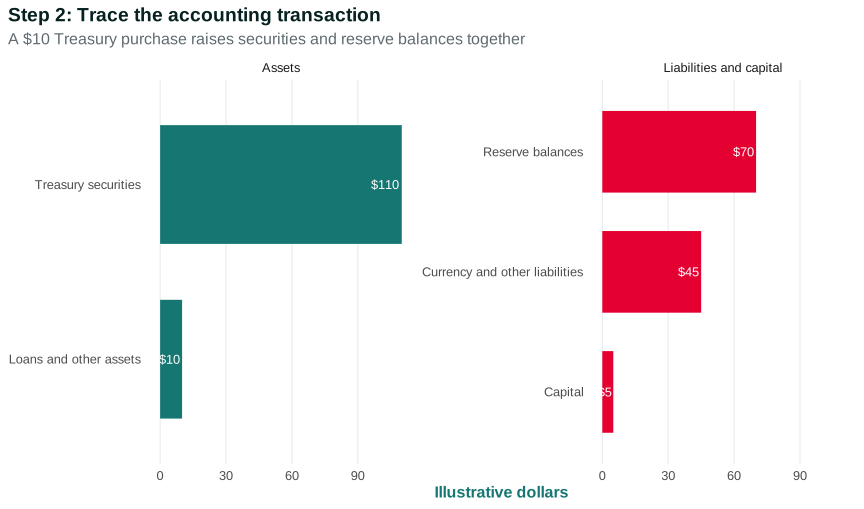
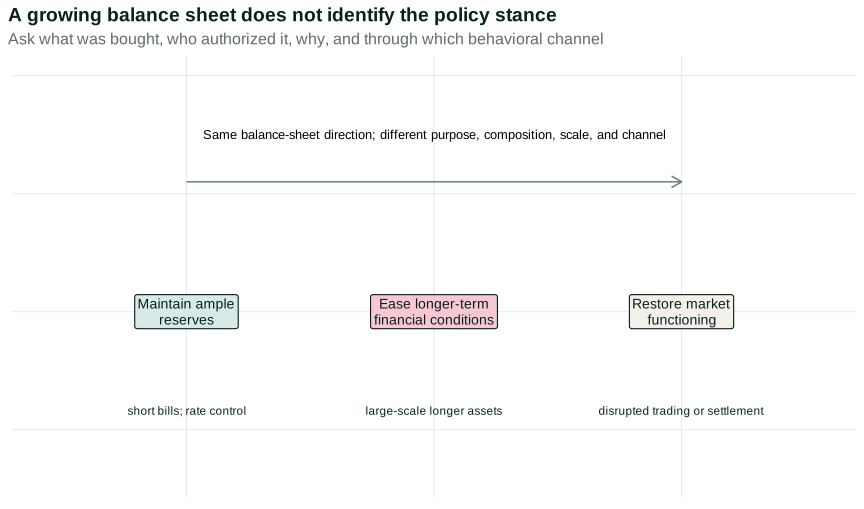
Open the live step-by-step figure
The accounting direction alone does not identify the policy purpose. A purchase of short Treasury bills can maintain an ample supply of reserves as currency or other liabilities grow. Large-scale purchases of longer-term securities can be intended to lower longer yields when the policy rate is near its effective lower bound. Purchases during market disruption can support trading and settlement. All can expand assets and reserves, but their intended channels, composition, scale, announcement, and economic context differ.
This distinction became especially useful after the Federal Reserve judged reserves to have reached ample levels in December 2025 and directed the Desk to begin reserve-management purchases. Those purchases of Treasury bills and, if needed, other short-maturity Treasury securities were designed to maintain ample reserves as demand for Federal Reserve liabilities grows and fluctuates. They were not described as a change in monetary-policy stance. Reserve-management purchases
Why can other liabilities affect reserves? Hold the asset side fixed. If the public wants more currency, banks obtain currency from Reserve Banks and reserve balances fall as currency liabilities rise. If tax payments raise the Treasury’s balance at the Fed, reserve balances can fall as the Treasury General Account rises. When the Treasury later spends, the direction can reverse. Reserves are a residual liability affected by several public transactions, not simply a lever the Fed moves in isolation.
Balance-sheet runoff reverses part of the expansion. When a Treasury security held by the Fed matures without reinvestment, the Treasury repays it. Depending on financing and other flows, Federal Reserve assets decline and reserve balances or another liability ultimately decline. The exact settlement path can involve the Treasury’s account and private holders, so “the Fed destroys money” is too compressed to teach the transaction accurately.
An open-market operation is a purchase or sale of securities conducted under Federal Reserve authority. Before 2008, frequent operations changed scarce reserve supply to keep the federal funds rate near a target. In the ample-reserves framework, operations still matter for maintaining reserve conditions, implementing standing facilities, changing balance-sheet policy, and supporting market functioning, but IORB is the primary rate-control tool.
Loans are different assets from securities. A discount-window or emergency loan creates a Federal Reserve asset—the borrower’s obligation—and ordinarily adds reserve balances or prevents their loss. Lending involves eligibility, collateral, maturity, pricing, and credit-risk rules. It can support liquidity without making an insolvent institution sound. Chapter 13 will examine lender-of-last-resort policy, runs, moral hazard, and loss allocation.
Balance-sheet policy affects power and risk. Eligible counterparties receive access to safe settlement assets or facilities. Asset purchases can change yields and asset prices. Emergency programs can protect payment networks, firms, jobs, and communities while shifting some risk toward public institutions. Excluding an institution can intensify failure; including it can protect creditors or owners and influence future risk-taking. Those choices require legal authority and public justification.
Students should ask four questions whenever the balance sheet changes:
- What transaction occurred? Identify the asset and liability entries.
- Who had authority? Separate the FOMC, Board, Reserve Bank, Desk, Treasury, and private counterparty.
- What was the purpose? Distinguish rate implementation, reserve management, accommodation, market functioning, and emergency lending.
- What behavioral channel is claimed? Do not infer an effect on lending, output, or inflation from accounting alone.
The balance sheet lets us compare today’s operating system with the framework many textbooks still present as if it were current.
Questions
Review the live step-by-step figure
Question 11.6. A Federal Reserve securities purchase increases assets and reserves. What can the accounting alone establish?
- The purchase was quantitative easing
- Inflation must rise
- The paired balance-sheet entries, but not the policy purpose
- Every bank made more loans
Exercise
Classify a balance-sheet action
For a Federal Reserve purchase, write the asset and liability entries, then list the evidence needed to distinguish reserve management from quantitative easing or a market-functioning operation.
The model solution is available in the restricted instructor materials.
11.7 From limited to ample reserves—and what to monitor
Before 2008, reserve balances were limited. Banks economized on non-interest-bearing reserves and borrowed more actively to meet payment and regulatory needs. The Federal Reserve used frequent open-market operations to adjust reserve supply so that the market federal funds rate stayed near a target. In that setting, a modest supply change could move the rate because the system operated on a steeper portion of banks’ demand for reserves.
After the Global Financial Crisis, large-scale asset purchases greatly increased reserve balances. Congress had authorized interest payments on reserves, and the Federal Reserve developed administered-rate tools for controlling short-term rates with an ample supply. Reserve requirements later ceased to be the center of implementation. The FOMC formally stated in 2019 that it intended to continue operating with ample reserves, using administered rates rather than active daily supply management as the main means of rate control.
| Question | Limited-reserves framework | Ample-reserves framework |
|---|---|---|
| Reserve condition | Banks hold relatively scarce balances | Supply is large enough that small changes have little rate effect |
| Main rate-control method | Frequent reserve-supply adjustment | Administered rates, especially IORB |
| Role of open-market operations | Daily fine-tuning of reserve supply | Maintain ample conditions and serve distinct balance-sheet purposes |
| Role of reserve requirements | Important source of reserve demand | Not the central operating tool; requirements are currently zero |
| Best first classroom story | Supply change moves an overnight rate | Safe outside options change bids, offers, and overnight rates |
| Main warning | Target is not the transaction rate | Ample is not infinite and does not eliminate frictions |
The older model is useful history, not a description to teach first. It explains why many diagrams place reserve supply at the center and why the term “open-market operations” became synonymous with ordinary rate changes. But using that framework as today’s baseline misidentifies the main tool and encourages the mistaken claim that reserve creation mechanically causes a fixed multiple of bank lending.
September 2019 provides a boundary lesson. Corporate tax payments and Treasury settlements drained reserves while financing demand rose. Repo rates spiked, pressure reached the federal funds market, and some institutions did not respond to high rates as a frictionless model predicted. Regulation, internal risk management, market relationships, and uncertainty limited the redistribution of liquidity. The Federal Reserve responded with repo operations and later Treasury-bill purchases. The episode did not show that the ample-reserves framework was impossible; it showed that “ample” must be inferred from market conditions and institutional behavior, not from a timeless dollar threshold.
The framework continues to evolve. By December 2025 the FOMC judged reserves to be in the ample range after balance-sheet runoff and began reserve-management purchases. The lesson is not to memorize a 2026 balance-sheet size. It is to monitor whether the EFFR remains controlled relative to the target and administered rates, whether money-market spreads and volatility indicate scarcity, how facilities are used, and how other liabilities change reserve supply.
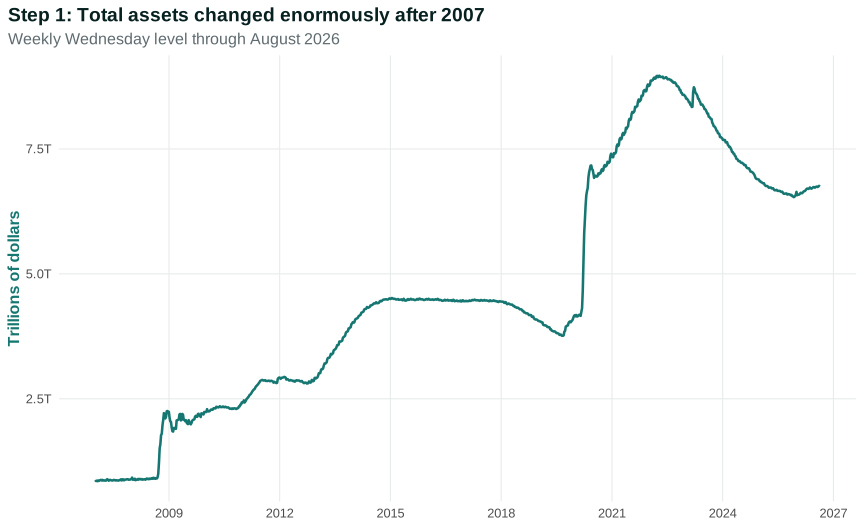
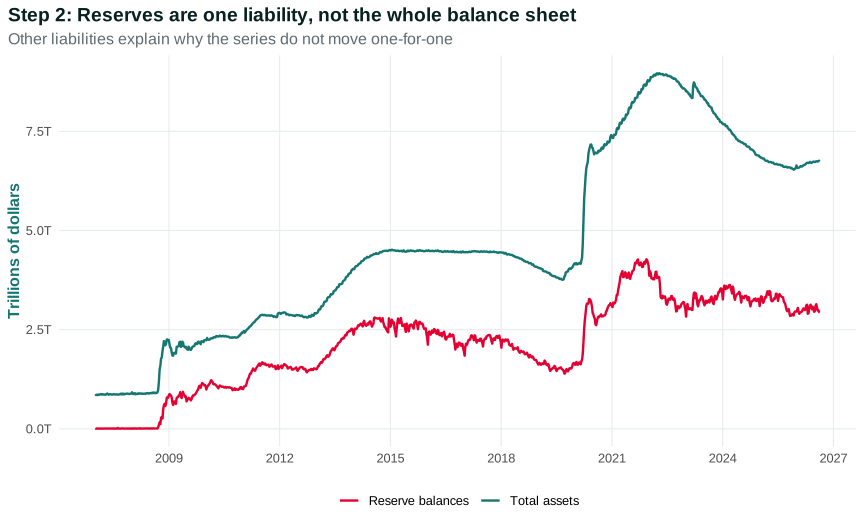
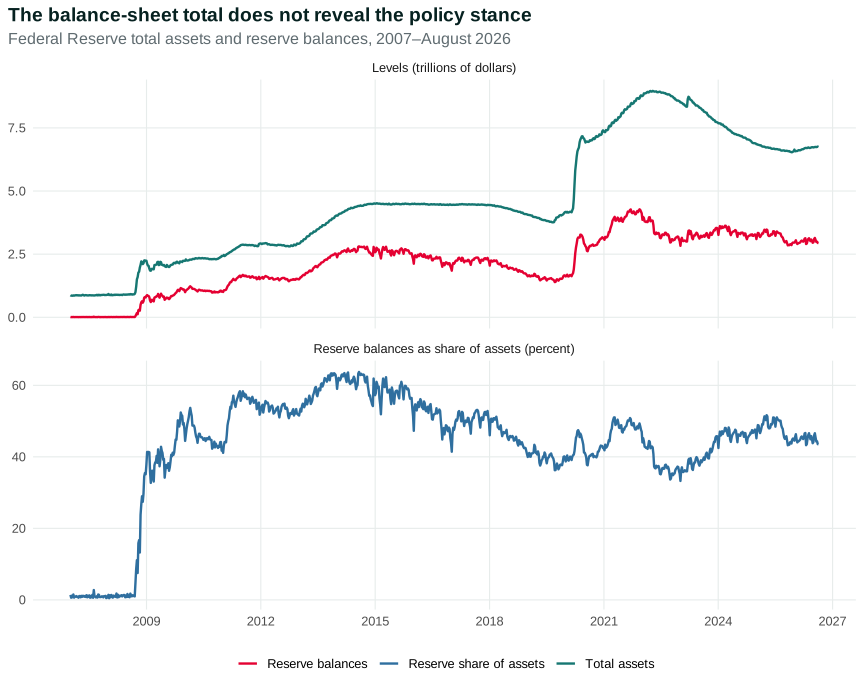
The first panel of Figure 11.5 plots the Federal Reserve’s total assets and reserve balances from 2007 through August 2026. Both series are weekly Wednesday observations in millions of dollars, converted to trillions. The second panel reports reserve balances as a share of total Federal Reserve assets. This ratio is a description of balance-sheet composition, not a measure of whether policy is easy or tight.
Open the live step-by-step figure
Use the dashboard in three passes. First, identify periods of large asset growth without assigning a cause from the line alone. Second, compare reserves with total assets and find periods when the gap changes. Third, use official documents to classify the transaction’s stated purpose—reserve management, accommodation, market functioning, or emergency lending.
Then combine the dashboard with Figure 11.3. A large balance sheet can coexist with different target ranges. A declining balance sheet can coexist with continuing control of the EFFR. The stance is not readable from the asset total alone.
Questions: Why can reserve balances fall while assets are nearly unchanged? What additional series would help identify which other liability changed? Why would a chart of total assets be insufficient evidence that policy became more expansionary?
Questions
Review the live step-by-step figure
Question 11.E1. Why can reserve balances change differently from total Federal Reserve assets?
- Reserves are the only Federal Reserve liability
- Other Federal Reserve liabilities and capital also share the balance sheet
- The accounting identity can fail
- The two series use no dates
Exercise
Diagnose the dashboard
Using Figure 11.5, identify one period when assets and reserves move together and one when their gap changes. Name an additional official series or document needed before assigning a mechanism.
The model solution is available in the restricted instructor materials.
The chapter’s answer can now be stated as a sequence. Congress establishes goals and legal powers. Governors and Reserve Bank presidents deliberate through a structured committee. The FOMC selects a target range; the Board and FOMC set relevant administered rates and instructions; the New York Fed’s Desk executes authorized operations. Eligible institutions respond to returns, risk, liquidity, regulation, and access. Their transactions produce the effective federal funds rate. Public documents and oversight make the exercise of delegated authority contestable and reviewable.
That operational chain is crucial but deliberately bounded. The Federal Reserve can control an overnight rate much more closely than it can control inflation or employment. After implementation come the conditional links from Chapter 10. Aggregate demand interacts with wage setting, price setting, expectations, productivity, supply constraints, market power, fiscal policy, and global shocks. The Phillips relationship remains conditional; it is not a menu from which the FOMC chooses a point.
This distinction protects the quality of the inflation analysis. Disinflation means a decline in the inflation rate while the price level may continue rising. Deflation means the price level falls. A central bank attempting to restore price stability generally seeks disinflation without an unnecessary collapse in employment, not a reversal of every past price increase. Whether tighter policy contributes to that outcome depends on the shock, expectations, transmission, lags, and the distribution of adjustment.
Chapter 12 turns from the central bank’s reserve accounts to households and firms that save, borrow, and face unequal credit terms. Chapter 13 then returns to banks, money creation, liquidity, capital, runs, and crisis intervention. Keep the balance-sheet discipline learned here: identify the actor, asset, liability, authority, behavioral response, feedback, and risk before making a macroeconomic claim.
Questions
Question 11.7. What primarily distinguishes rate control in today’s ample-reserves framework?
- Daily fine-tuning of scarce reserve supply
- Administered rates steer short-term market rates while reserves remain ample
- A fixed legal money multiplier
- The total asset level directly selects inflation
Exercise
Replace the old story
Rewrite a textbook claim that the Fed raises rates by selling bonds and reducing money. Make it accurate for both limited- and ample-reserves frameworks without using more than 120 words.
The model solution is available in the restricted instructor materials.
Seeing the principles in action
| Principle | Example | Everyday Economics |
|---|---|---|
| Interdependence principle — focal | Administered rates, overnight markets, reserve holdings, Treasury flows, regulation, and payment settlement affect one another. | A tax payment can move reserves even when the FOMC leaves its target unchanged. |
| Doing the best you can principle | Banks compare safe reserve returns, private lending opportunities, liquidity needs, regulation, and counterparty risk. | A bank may hold reserves rather than accept a lower, riskier overnight rate. |
| Rules of the game principle — focal | Law, appointments, voting rotation, account access, facility eligibility, and collateral rules determine who can decide and transact. | A money market fund may use ON RRP but cannot earn IORB like an eligible bank. |
| Trade-offs and opportunity costs principle | Operational independence can lengthen policymakers’ horizon while increasing the need for strong accountability and accessible explanation. | Insulation from one election also limits voters’ direct control over a rate decision. |
| Principle of gains from cooperation and conflict of interest — focal | Reliable payments and price stability can create broad gains, while policy costs and facility access generate distributional conflict. | Rate control can work even as borrowers, savers, workers, and asset owners experience different effects. |
| Principle of individual and societal interests | One bank can protect liquidity by hoarding reserves, while many banks doing so can intensify money-market stress. | A cautious private response can make system-wide funding harder to redistribute. |
| Principle of aggregation and feedback | Payments redistribute reserves across banks, while Federal Reserve and Treasury transactions change their aggregate supply and can feed back into market rates. | A customer’s payment changes two banks’ reserves but not the system total. |
Skills and learning objectives
- Distinguishing policy decisions from implementation
- Mapping Federal Reserve authority and accountability
- Tracing reserve payments through balance sheets
- Explaining administered-rate incentives
- Reading the Federal Reserve balance sheet
- Comparing limited- and ample-reserves frameworks
- Evaluating operating-framework data without inferring the policy stance
Concepts to learn
- Federal Reserve System
- Board of Governors
- Federal Reserve Banks
- Federal Open Market Committee
- Reserve balances
- Federal funds market
- Effective federal funds rate
- Target range
- Interest on reserve balances
- Overnight reverse repurchase agreement facility
- Ample reserves
- Open-market operations
- Central-bank balance sheet
- Central-bank independence
- Accountability
- Transparency
Glossary
Chapter 11 terms
Board of Governors
The federal agency whose governors help make monetary policy, oversee the Federal Reserve System, and set certain administered rates including IORB.
See also: Federal Open Market Committee; Federal Reserve Bank.
Federal Reserve Bank
One of twelve regional operating institutions that provides central-bank services, maintains eligible institutions’ accounts, and participates in policymaking.
See also: Board of Governors; Federal Open Market Committee.
Federal Open Market Committee
The Federal Reserve System body that selects the target range for the federal funds rate and directs open-market operations.
See also: target range; Board of Governors.
central-bank independence
An institutional allocation in which central-bank policymakers can adjust authorized instruments without obtaining political approval for every decision, while remaining subject to law and accountability.
See also: accountability; transparency.
accountability
The obligation of central-bank officials to act within delegated authority, explain decisions and uncertainty, disclose relevant evidence, and remain answerable to Congress and the public.
See also: central-bank independence; transparency.
transparency
Communication that lets the public identify a central-bank decision, responsible actor, reasoning, uncertainty, and implementation mechanism.
See also: accountability.
reserve balance
A deposit held by an eligible institution at a Federal Reserve Bank; it is the institution’s asset and the Federal Reserve’s liability.
See also: federal funds market; central-bank balance sheet.
federal funds market
The market in which eligible institutions borrow and lend Federal Reserve account balances overnight without pledged collateral.
See also: effective federal funds rate; reserve balance.
effective federal funds rate
The volume-weighted median rate on eligible overnight federal funds transactions, published for the previous business day by the New York Fed.
See also: federal funds market; target range.
target range
The interval for the federal funds rate selected by the FOMC to express and implement the current monetary-policy stance.
See also: Federal Open Market Committee; effective federal funds rate.
ample-reserves framework
An operating system with enough reserve balances that administered rates, rather than daily fine-tuning of reserve supply, are the primary means of controlling short-term rates.
See also: interest on reserve balances; overnight reverse repurchase agreement facility; reserve balance.
interest on reserve balances
The interest rate paid by the Federal Reserve on eligible institutions’ reserve balances and the main rate-control tool in the ample-reserves framework.
See also: ample-reserves framework; overnight reverse repurchase agreement facility.
overnight reverse repurchase agreement facility
A Federal Reserve facility that offers eligible money-market counterparties a safe overnight investment and helps limit downward pressure on short-term rates.
See also: interest on reserve balances; ample-reserves framework.
central-bank balance sheet
A record of a central bank’s assets, such as securities and loans, and liabilities, such as currency, reserve balances, and government deposits.
See also: reserve balance; open-market operation.
open-market operation
A purchase or sale of securities or a repo transaction conducted under central-bank authority to implement policy, manage reserves, or serve another stated operational purpose.
See also: central-bank balance sheet; ample-reserves framework.
Flashcards
What is the difference between a target range and the EFFR?
The FOMC chooses the target range; the EFFR is a statistic constructed from actual overnight market transactions.
Why is a reserve balance both an asset and a liability?
It is an asset of the eligible institution holding it and a liability of the Federal Reserve that owes the balance.
What is the main rate-control tool in the ample-reserves framework?
Interest on reserve balances, supported by facilities including ON RRP and standing repo operations.
Why does a larger Federal Reserve balance sheet not automatically mean easier policy?
Similar asset and reserve changes can serve reserve management, accommodation, or market functioning; purpose, composition, and the target range must be identified.